
SUNLU High Toughness Resin
4.7Editor score
High toughness performance
Low shrinkage rate
Widely compatible formula
Compare the top flexible resin for 3D printing. This guide reviews ten durable, impact-resistant resins for functional prints and prototypes.
Flexible resin for 3D printing allows creators to produce parts that bend, stretch, and absorb shock like rubber or TPU. Choosing the right formula ensures your prints withstand stress without cracking or losing shape over time.
We analyzed ten leading flexible resins based on Shore hardness, elongation, impact resistance, and printability. Each option offers unique traits for prototyping, functional parts, or creative designs requiring durability and flexibility.
Our picks highlight standout features like fast curing, low odor, and balanced softness. Prices and availability change frequently, so verify current details before purchasing to ensure the best fit for your printer and project needs.
4.7Editor score
4.7Editor score
4.2Editor score
This side-by-side comparison highlights key specs for each flexible resin. Use it to find the best match for your printer type and project requirements.



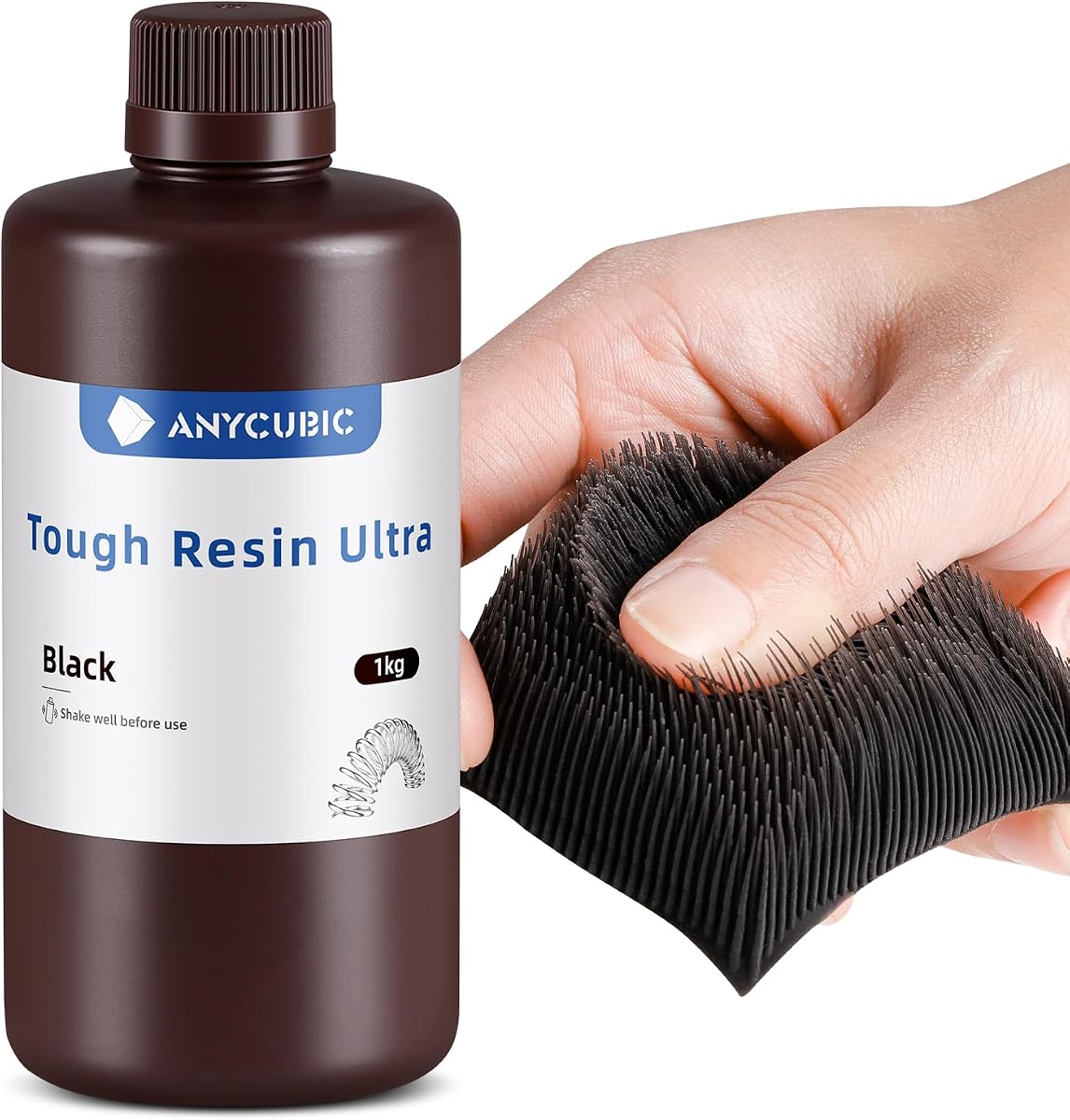
ANYCUBIC Ultra Tough Resin stands out with a 4.7 rating for its exceptional balance of flexibility and impact resistance. This resin excels in creating parts that recover swiftly after deformation, making it perfect for functional prototypes and wearables.
We may earn a commission when you buy through this link, at no additional cost to you.
Its capacity to resist damage while allowing seamless movement in articulated models sets it apart. The non-irritating formulation ensures comfort in daily wear items like earphone covers, while its durability withstands high humidity and damp environments.
While blending it with other resins may alter final colors, this trade-off is minimal compared to its benefits. It offers robust adaptability without softening or corroding, ensuring long-term performance even under stress.
Buy this if you need reliable flexibility for daily-use models or require an additive to enhance existing tough resins. It remains a top choice for makers prioritizing both resilience and skin-friendly output.
This resin swiftly returns to its original shape after external force deformation, ensuring high resistance to damage over repeated use cycles.
After curing, it provides a non-irritating surface ideal for wearable items like elf ears or daily-use covers that touch skin frequently.
We may earn a commission when you buy through this link, at no additional cost to you.
SUNLU High Toughness Resin earns a 4.7 rating for its enhanced flexibility and 5 times higher elongation than standard resins. It delivers unbreakable models with improved accuracy and low distortion during curing.
We may earn a commission when you buy through this link, at no additional cost to you.
Its low viscosity ensures shorter curing times and easier model formation, while minimal shrinkage preserves detail. The low-odor formula creates a comfortable printing environment, and cleaning is straightforward with alcohol or ethanol.
The only limitation is its fixed grey color, which might not suit all visual needs. However, for structural parts and functional prototypes, its durability and compatibility with most LCD/DLP printers make it a budget-friendly standout.
Choose this if you need reliable toughness for high-performance prints without compromising on precision. It is ideal for makers seeking cost-effective solutions that still deliver professional-grade results.
This resin offers elongation 5 times higher than regular standard resin, making your printed models unbreakable and durable for high-toughness applications.
Reduced volume shrinkage during curing minimizes distortion, allowing you to achieve best-in-class accuracy and crisp detail in your prints.
We may earn a commission when you buy through this link, at no additional cost to you.
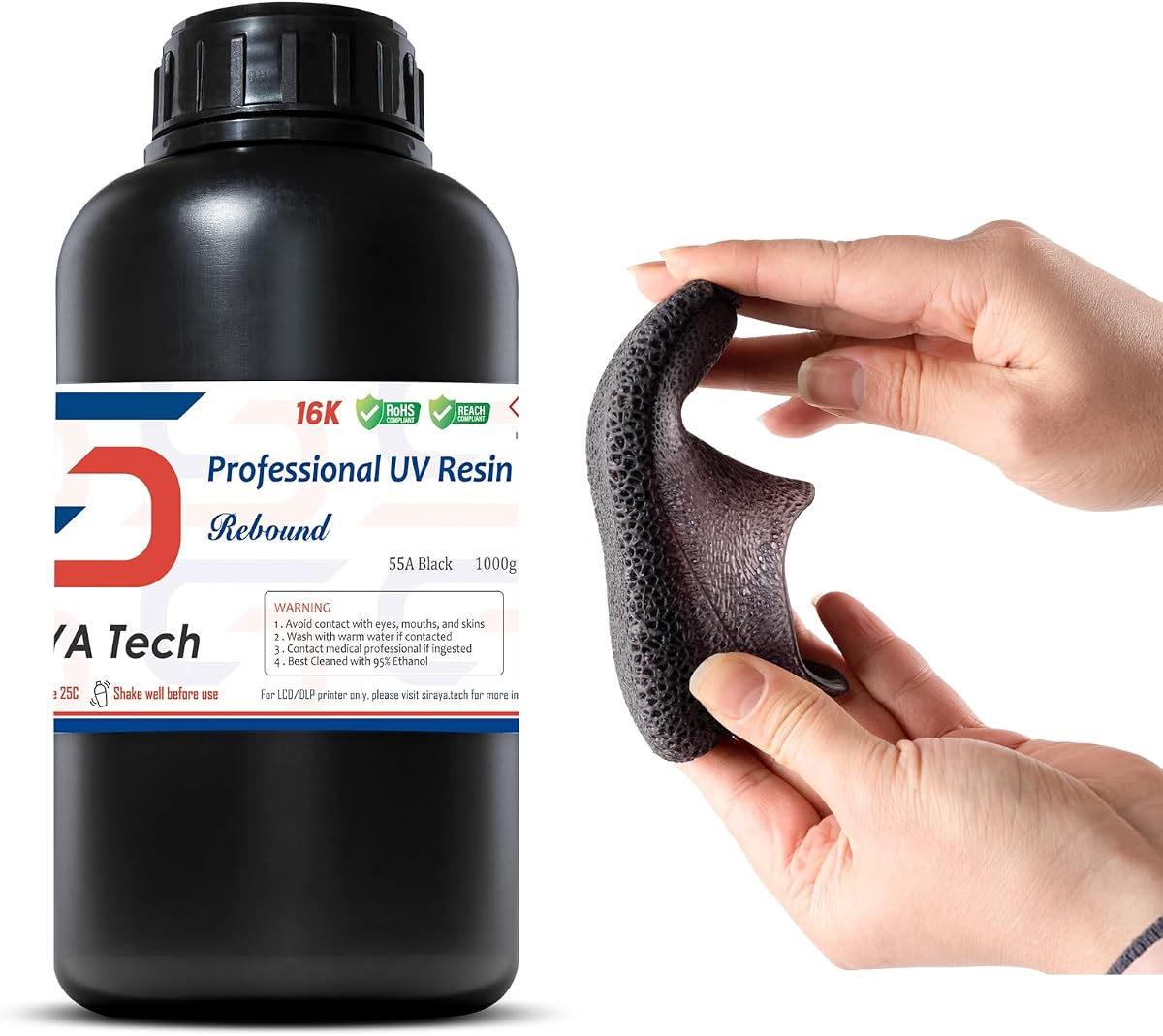
Siraya Tech Rebound 55A earns a 4.2 rating for providing significantly faster rebound than standard elastic resins. This black 1kg resin is excellent for applications requiring quick shape recovery and impact absorption like personal protective equipment prototypes.
We may earn a commission when you buy through this link, at no additional cost to you.
Its 55A Shore hardness offers a balanced mix of flexibility and structural integrity, softer than Tenacious Flex but with excellent compression properties. Unlike complex elastomers, it prints on standard LCD/DLP printers and cleans with standard isopropyl alcohol methods.
Initial testing shows good resilience during compression cycles, though long-term performance testing is ongoing. This trade-off is acceptable given its superior rebound speed and ease of use compared to other premium options on the market.
Purchase this if you need shock-absorbing components or industrial prototyping with high elasticity requirements. It remains a top choice for specialized applications where rebound performance outweighs long-term data.
Provides significantly faster rebound than standard elastic resins, making it ideal for applications needing quick shape recovery and impact absorption.
Unlike other elastomers, it prints on standard LCD and DLP 3D resin printers and cleans with standard isopropyl alcohol methods.
We may earn a commission when you buy through this link, at no additional cost to you.
Superflex 3D Printer Resin is a clear 500g option with a 4.4 rating for its fast printing and balanced softness. It prints 50um layers in just 1.7 seconds, enhancing productivity by at least 40% on monochrome LCD printers.
We may earn a commission when you buy through this link, at no additional cost to you.
Its 80A Shore hardness and 100% elongation make it ideal for cushioning, damping, and shock absorption needs. Properly cleaned and post-cured prints pass the ISO 10993-5 test, ensuring safety and performance standards.
The clear color may limit tinting flexibility compared to black or grey resins. However, its speed and biocompatibility certification make it a practical choice for prototyping and functional parts requiring specific safety checks.
Choose this if you need high-speed production for flexible prototypes or require biocompliant materials. Its combination of speed and certified safety adds unique value for specialized 3D printing farms.
Super fast printing enhances the productivity of 3D printing farm by at least 40% and up, saving on time and electricity bills.
Properly cleaned and fully post cured prints pass ISO 10993-5 test, ensuring safety for specific applications needing certified materials.
We may earn a commission when you buy through this link, at no additional cost to you.
SUNLU Flexible 3D Printer Resin is a 1000G gray option with a 3.5 rating for its balanced softness and strength. It features 70A Shore hardness and 135% elongation at break, ensuring models are bendable and not brittle.
We may earn a commission when you buy through this link, at no additional cost to you.
It offers a high-resolution smooth surface finish with low shrinkage, providing accurate size and shape retention. The minimal odor and safe materials make it comfortable for extended printing sessions, while stability resists weak acids and greases.
Though its rating is lower than some competitors, its consistent performance and low shrinkage rate offer reliability for general use. It may not excel in extreme impact scenarios but works well for standard flexible prototypes.
Opt for this if you need a reliable flexible resin for general modeling with a smooth finish. Its stability and low odor provide practical benefits for makers prioritizing usability and accuracy over high impact resistance.
This resin offers a high-resolution, smooth surface finish. After cleaning, you get a dry, non-sticky surface with a pleasant touch.
During curing, it has a low shrinkage rate, providing accurate size and shape of printed parts for reliable dimensional consistency.
We may earn a commission when you buy through this link, at no additional cost to you.
Siraya Tech Tenacious Highly Flexible offers a 500g black resin with a 4.7 rating. It is significantly softer and more rubber-like than classic Tenacious, providing faster rebound and incredible elasticity for flexible prints.
We may earn a commission when you buy through this link, at no additional cost to you.
Its superior elasticity allows models to withstand extreme bending and compression, quickly returning to shape. The high impact resistance ensures durability without brittleness, and it serves as an excellent additive to boost toughness in other resins.
Note that it may not suit all applications where the original Tenacious resin is typically used due to its softer nature. This trade-off makes it perfect for specialized flexible needs rather than general tough prints.
Buy this if you need dynamic flexible prints like gaskets or pliable prototypes. Its exceptional rebound properties and additive potential make it a standout for specialized projects requiring high flexibility.
This new formulation offers faster rebound and incredible elasticity, perfect for flexible and resilient 3D prints requiring high elasticity.
Mix with other resins to boost impact resistance and flexibility. A small addition can significantly enhance the properties of your prints.
We may earn a commission when you buy through this link, at no additional cost to you.
ANYCUBIC Tough Resin 2.0 offers a grey 1kg option with a 4.6 rating for its upgraded high toughness. It demonstrates enhanced flexural strength and strong elongation to resist cracking and stress marks from vibrations.
We may earn a commission when you buy through this link, at no additional cost to you.
Its low-odor formulation reduces volatile organic compounds, creating a comfortable printing environment. It maintains excellent precision with minimal shrinkage, ensuring smooth surfaces and clear details across various industrial and maker applications.
The grey color limits aesthetic versatility compared to clear options. However, its durability and environmental friendliness make it ideal for functional parts and spare parts requiring high strength and low irritation.
Choose this if you need a robust resin for industrial spare parts or high-strength model production. Its low-odor and high precision provide reliable performance for users prioritizing comfort and quality.
Underwent a comprehensive upgrade in terms of flexural strength, demonstrating enhanced toughness and making it less prone to fracture when printing miniature components.
Featuring a low odor and non-irritating composition, it reduces volatile organic compounds, making it a green and environmentally friendly choice.
We may earn a commission when you buy through this link, at no additional cost to you.
ELEGOO Tough 3D Printer Resin is a black 1000g option with a 4.5 rating for its high toughness and resilience. It has a Shore hardness of 84.7D and can withstand tension and stress while recovering quickly from deformation.
We may earn a commission when you buy through this link, at no additional cost to you.
Its physical properties allow drilling without cracks and resist corrosion even in high humidity. The low odor and non-irritating properties make it comfortable for long sessions, suitable for tools and engineering prototypes.
With a Shore hardness of 84.7D, it is stiffer than highly flexible options, limiting extreme bending scenarios. However, its weather resistance and strength make it ideal for industrial parts requiring durability.
Buy this if you need end-use products or tools that must survive tough conditions. Its durability and comfort during printing offer a reliable choice for engineers and makers seeking high-performance black resin.
The material has a fine texture and shows excellent resistance to brittleness, softening, and corrosion even in high humidity environments.
It has high-strength physical properties and can withstand certain impacts, making it very suitable for printing structural parts and tools.
We may earn a commission when you buy through this link, at no additional cost to you.
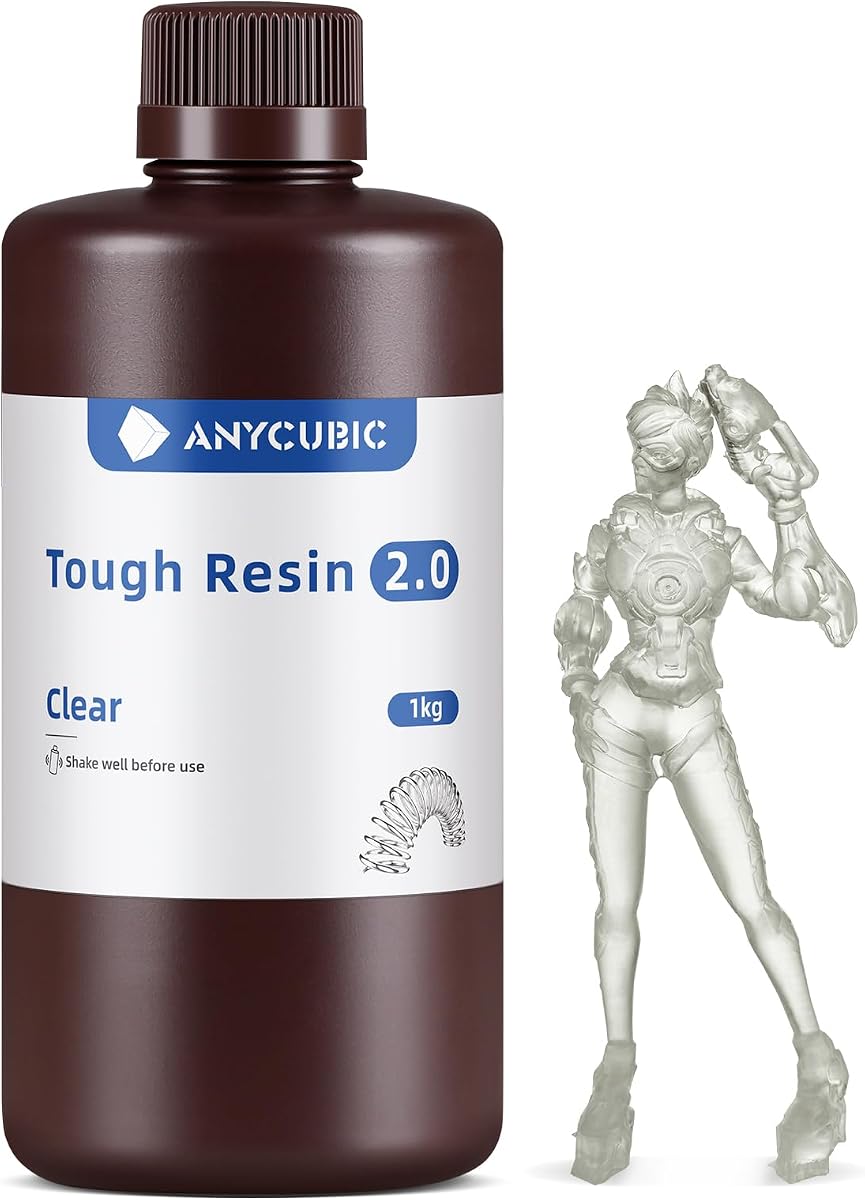
ANYCUBIC Tough 3D Printer Resin 2.0 is a clear 1kg option with a 4.6 rating. It achieves significant enhancement in flexural strength and offers exceptional stretch to resist damage from cyclic vibrations.
We may earn a commission when you buy through this link, at no additional cost to you.
Its low-odor design creates a pleasant environment by cutting volatile organic compounds. It ensures high precision prints with minimal shrinkage, and offers industry-wide compatibility with different equipment and materials.
The high hardness reduces extreme flexibility compared to softer resins. However, for parts needing both strength and some stretch, it delivers reliable performance for professional and technical applications.
Choose this if you need clear, precision parts that withstand vibrations and drops. Its environmental design and compatibility make it a strong pick for industry-standard production.
This resin ensures high precision prints with minimal shrinkage, delivering consistent quality and clear details for technical applications.
With its minimal odor and composition gentle on users, it paves the way for a serene and pleasant printing environment for all.
We may earn a commission when you buy through this link, at no additional cost to you.
This 1000g black resin has a 4.4 rating for simulating rubber toughness with Shore 90A hardness. It folds and bends repeatedly without breaking and offers strong tear resistance for real-world components like toy tires and ergonomic grips.
We may earn a commission when you buy through this link, at no additional cost to you.
You get crisp accurate prints without sacrificing detail for flexibility. The low-odor formula ensures comfortable printing sessions, and the material handles shock-absorbing components, medical models, and cosplay props efficiently.
With Shore 90A hardness, it is harder than softer Shore options. This trade-off makes it durable for end-use parts requiring structural integrity while remaining flexible enough for stress tests.
Buy this if you need parts to stay flexible under repeated stress without wearing out. Its balance of precision and durability makes it ready for end-use production immediately.
This 90A Shore hardness can simulate the toughness of rubber, with both softness and strength for folding and bending without breaking.
It handles end-use parts like gaskets and shoe soles that need to stay flexible under repeated stress while remaining tough enough.
We may earn a commission when you buy through this link, at no additional cost to you.
Selecting the right flexible resin depends on your project's needs for hardness, durability, and printing conditions. Consider these key factors to ensure optimal performance.
Shore hardness determines how soft or stiff your print will be. A lower A value like 55A offers extreme flexibility and rubber-like feel, while higher values like 90A provide more structural support with moderate bending.
Choose a Shore hardness that matches the physical requirements of your model to ensure it bends without breaking under expected stress.
Elongation at break measures how much a printed part can stretch before failing. Resins with higher percentages allow for greater deformation and recovery, essential for parts that undergo repeated stretching or compression.
Look for resins with high elongation ratings to maximize the flexibility and durability of your functional prints.
Impact resistance refers to the material's ability to withstand sudden shocks or drops. Resins with enhanced toughness prevent cracking or shattering when models fall or are subjected to dynamic loads.
Prioritize impact-resistant formulations for models that will be handled frequently or used in environments with physical hazards.
Flexible resins are generally optimized for 405nm wavelengths, but some may require specific ranges like 365nm to 405nm. Always check your printer's light source to ensure compatibility and proper curing.
Verify wavelength compatibility with your printer to avoid under-cured parts or excessive printing times.
Shrinkage occurs as resin cures and hardens. Flexible resins often exhibit low shrinkage to maintain dimensional accuracy, ensuring parts fit together correctly without warping or size distortion.
Select resins with low shrinkage for precise models requiring tight tolerances and accurate assembly.
Flexible resins can emit odors during printing. Low-odor formulations with reduced volatile organic compounds (VOCs) create a safer and more comfortable environment, especially in non-industrial settings.
Opt for low-odor options if you print in shared or ventilated spaces to minimize exposure to chemicals.
Flexible prints often require careful cleaning and post-curing to avoid stickiness. Ensure the resin works with standard cleaning solvents like isopropyl alcohol and provides a stable surface after curing.
Choose resins that simplify post-processing to save time and ensure a non-tacky finish for your final products.
Most flexible resins work with LCD, DLP, and SLA printers. However, check compatibility with specific screen types like monochrome or color LCD to maximize print speed and accuracy.
Ensure the resin matches your printer's capabilities to avoid compatibility issues during the printing process.
Store flexible resin in a cool, dark place to prevent premature curing. Keep bottles tightly sealed when not in use to avoid air exposure and contamination.
Shake the resin bottle gently before pouring to ensure uniform consistency. Use a dedicated bucket for printing to prevent cross-contamination with other resin types.
Clean printed parts with isopropyl alcohol after printing and follow manufacturer instructions for post-curing. Proper curing ensures the flexible properties and durability of the final print.
Flexible resin is formulated to be bendable and rubber-like, allowing prints to absorb shock and stretch without breaking. Standard resin is rigid and brittle, making it better suited for detailed models that do not require flexibility. The additives in flexible resin increase elongation and impact resistance.
Flexible resins may require adjusted exposure times and lift speeds due to their different curing properties. Start with manufacturer recommendations and test small calibration prints to find optimal settings. Some printers may need slower peeling speeds for better layer adhesion.
Avoid over-flexing parts by supporting thin or complex features adequately with supports. Ensure proper calibration of your printer's Z-axis to prevent uneven layer heights. Adjust exposure times to ensure complete curing without under-curing, which weakens the structure.
Many flexible resins are non-irritating and safe for skin contact after proper post-curing. Look for certifications or safety data sheets confirming biocompatibility if the part will touch skin directly. Always wear protective gear during handling to minimize exposure before curing.
Yes, flexible resin can be mixed with standard resin to enhance toughness while maintaining detail. Mix small batches first to test the resulting flexibility and color change. Keep mixtures well-stirred to ensure consistent properties throughout the batch.
Sticky prints often result from insufficient curing or incomplete cleaning. Increase post-curing time and ensure the print is thoroughly washed before curing. Avoid using too much IPA during cleaning as it may leave residues that affect the surface.
Flexible resin typically lasts 6 to 12 months if stored properly in a cool, dark place. Keep the bottle tightly sealed and avoid exposing it to direct sunlight to prevent premature curing. Check the manufacturer's expiration date for best results.
80A Shore resin is ideal for cushioning, damping, and shock-absorbing components that need moderate flexibility. It is well-suited for gaskets, protective cases, and prototypes requiring a rubber-like texture. This hardness balances strength and bendability for durable parts.
Our top picks include ANYCUBIC Ultra Tough Resin for its overall resilience, SUNLU High Toughness Resin for budget-friendly durability, and Siraya Tech Rebound 55A for premium elasticity. Each offers unique advantages for functional parts and prototypes requiring flexibility and strength.
Prioritize factors like Shore hardness, elongation, and impact resistance based on your project needs. For wearables, choose non-irritating formulations; for industrial parts, look for weather resistance and chemical stability.
Always verify current prices and availability before purchasing, as these factors can change frequently. Select the resin that best fits your printer capabilities and application requirements for optimal results.