
1/2 Flow Hall Sensor with NPT Thread
4.7Editor score
Compact design with NPT thread
Accurate 1 to 30L per minute range
Sealed hall effect sensor for safety
Arduino flow meters are essential tools for makers and engineers monitoring water usage in smart home or industrial applications. Choosing the right sensor ensures accurate data collection for irrigation systems or beverage dispensers.
We evaluated ten highly rated sensors based on flow range, build quality, and compatibility with microcontrollers like Raspberry Pi. Each option offers unique threading and voltage specs for diverse project needs.
Each pick highlights specific strengths such as food-grade materials or extended cable lengths. Prices fluctuate frequently so verify current offers before purchasing your preferred model today.
4.7Editor score

5.0Editor score

4.9Editor score
As an Amazon Associate we earn from qualifying purchases.
The following table offers a side-by-side comparison of all ten selected flow meters. Check specifications like flow range, voltage, and threading to find the best fit for your specific application requirements.


This sensor offers a budget friendly entry into water flow measurement for Arduino projects. It has a strong rating of 4.7 and provides reliable pulse outputs for tracking usage accurately in various setups.
We may earn a commission when you buy through this link, at no additional cost to you.
The built-in magnetic hall effect sensor ensures that electrical pulses are generated with every rotor revolution. It is sealed from the water pipe which keeps the electronics dry and safe from moisture corrosion over time.
While the flow range is capped at 30 liters per minute this unit is not suitable for high volume industrial applications. Installing it in the reverse direction means no signal output so users must respect the flow arrow.
This pick is ideal for home water purification or small coffee machine projects where cost matters. It delivers consistent performance without breaking the bank making it a top choice for entry level makers today.
The sensor design isolates the electrical components from water contact. This ensures longevity even in humid or wet environments common in plumbing setups.
The NPT thread allows for straightforward connection to standard piping. Installers can use basic tools to secure it without needing complex adapters.
We may earn a commission when you buy through this link, at no additional cost to you.
This unit stands out with a near perfect 4.9 rating due to its robust electrical performance and clear signal output. It is designed for applications requiring precise flow control like cooling systems or vending machines.
We may earn a commission when you buy through this link, at no additional cost to you.
The high amplitude signal makes it easy for microcontrollers to read the data without noise interference. With electric strength rated up to 1250V per minute it handles tough conditions without failure.
Users might find the price slightly higher than generic options but the reliability justifies the cost. It is not designed for massive industrial flow rates but excels in controlled environments.
Buyers looking for a high reliability component for critical systems should choose this model. Its build quality and signal clarity make it a premium choice for serious engineering projects.
High amplitude ensures the signal is strong enough for sensitive electronics. This reduces the need for additional signal amplification in circuit designs.
The rated electric strength protects the device from voltage spikes. This feature extends the lifespan in environments with unstable power supplies.
We may earn a commission when you buy through this link, at no additional cost to you.
This sensor achieves a perfect 5.0 rating offering a wide flow range that covers many industrial and residential needs. Its robust build quality and high pressure resistance make it suitable for main water lines.
We may earn a commission when you buy through this link, at no additional cost to you.
It is made with ROHS compliant materials ensuring it is safe for use with potable water. The square wave output provides clear pulse signals for accurate flow calculation in software.
While the G1.5 inch thread may require seal tape if adapting to NPT pipes the performance outweighs this minor inconvenience. The pressure resistance is significantly higher than smaller models.
This is the top recommendation for projects needing high flow capacity without sacrificing accuracy. Its reliability and material safety make it the best overall choice for diverse applications.
Capable of measuring from 5 up to 150 liters per minute. This covers everything from small appliances to main feed lines effectively.
All materials comply with ROHS standards for health safety. You can use this sensor for drinking water systems with confidence.
We may earn a commission when you buy through this link, at no additional cost to you.
This model focuses on safety with food grade plastic that is safe for contact with potable water. It fits standard G1/2 BSPT threads making it easy to install in existing pipes quickly.
We may earn a commission when you buy through this link, at no additional cost to you.
The wide working voltage range allows for flexibility in power sources across different Arduino boards. It uses a reliable hall effect switch to generate pulse signals for accurate data logging.
Some users report a lower rating compared to other brands which might indicate variability in manufacturing quality. However for simple projects it performs well within the expected limits.
It is a solid choice for basic water monitoring tasks where cost is a priority. Ensure you check the flow direction label during installation to avoid reading errors.
The plastic body meets safety standards for direct water contact. This is critical for projects involving drinking water or beverages.
Supports operation from 5 up to 24 volts DC. This flexibility allows it to work with various Arduino power setups easily.
We may earn a commission when you buy through this link, at no additional cost to you.
This option provides a transparent body which allows users to visually inspect the impeller for debris or jams. It comes as a pack of two which is great for spare parts or multiple projects.
We may earn a commission when you buy through this link, at no additional cost to you.
The impeller uses stainless steel beads for better wear resistance compared to plastic counterparts. The working voltage range extends down to 3.5V which helps in battery powered setups.
Despite these features the rating is lower than average indicating potential inconsistency in sensor performance across units. The transparent body might yellow over time with UV exposure.
Choose this if you need to verify flow visually without a display unit. It is good for educational projects where seeing the rotor spin helps understand the technology.
The clear plastic lets you see water flow directly. This helps in troubleshooting blockages or rotor jams quickly.
Steel beads in the impeller reduce wear over time. This extends the operational life of the sensor under stress.
We may earn a commission when you buy through this link, at no additional cost to you.
This sensor is specifically designed for very low flow applications like drip irrigation or small tubing. It connects directly to hosepipes with an inner diameter of 5 to 7 mm for easy setup.
We may earn a commission when you buy through this link, at no additional cost to you.
It maintains food grade safety standards making it suitable for portable water systems or small drink dispensers. The low flow range ensures high accuracy at small volumes where larger sensors fail.
The trade off is that it cannot handle standard water line pressures or flows. If your application requires more than 3 liters per minute this model will not suffice.
It is perfect for specialized projects involving precise small volume delivery. Ensure you match the hose diameter correctly to avoid leaks during operation.
Designed for flows as low as 0.5 liters per minute. This level of sensitivity is rare in standard meters.
Fits hosepipes with specific inner diameter. This simplifies installation for custom tubing projects.
We may earn a commission when you buy through this link, at no additional cost to you.
This unit is targeted at water heater applications to detect influent flow rate accurately. It earns a perfect 5.0 rating for its reliable performance in regulating heating elements based on flow speed.
We may earn a commission when you buy through this link, at no additional cost to you.
The magnetic rotor rotates at speeds changing with the flow rate and feeds signals to the controller. This allows for precise regulation of temperature or power consumption in heating systems.
Users looking for general flow measurement might find the interface specific. It is not a universal sensor but excels in its intended application of water heating management.
This pick is best for DIY water heater projects or replacements for broken units. Its regulation capabilities make it a key component for safe and efficient heating.
Installed at water inlet to measure incoming flow. This ensures accurate control of the heating process.
Outputs pulse signals for controller regulation. This enables automated control based on real time data.
We may earn a commission when you buy through this link, at no additional cost to you.
This version comes with a 1.2 meter cable which offers significant flexibility for placing the sensor away from the main controller. It has a high rating of 4.8 and maintains the same accuracy as the standard model.
We may earn a commission when you buy through this link, at no additional cost to you.
The waterproof design ensures it survives in humid environments like basements or under sinks. The cable ends in a SM2.54 connector which simplifies wiring to microcontroller boards directly.
The extended length is a major advantage for projects where the sensor must be far from the board. It avoids the need for extra wiring which could introduce signal noise.
Buyers needing placement flexibility should choose this model. It combines standard performance with the added benefit of a longer connection cable for easier installation.
1.2 meters of cable allows sensor placement up to four feet away. This helps in tight mechanical spaces.
Uses SM2.54 3P connectors for reliable electrical contact. This prevents loose connections during operation.
We may earn a commission when you buy through this link, at no additional cost to you.
This sensor is designed for small spaces with a compact body that fits into tight enclosures. It has a flow range from 0.3 to 10 liters per minute which is ideal for small appliances.
We may earn a commission when you buy through this link, at no additional cost to you.
It operates on a lower voltage range starting at 3.5V which is great for portable battery powered projects. The square wave output is standard and easy to read with most controllers.
The trade-off is the smaller flow capacity compared to 1/2 inch models. It is not suitable for high volume tasks but excels at precise measurement in limited areas.
This pick is best for projects with space constraints. It offers reliable performance in a smaller form factor for specialized applications.
The small size allows installation in confined areas. This is useful for custom enclosures.
Starts working at 3.5 volts DC. This makes it ideal for battery operated systems.
We may earn a commission when you buy through this link, at no additional cost to you.
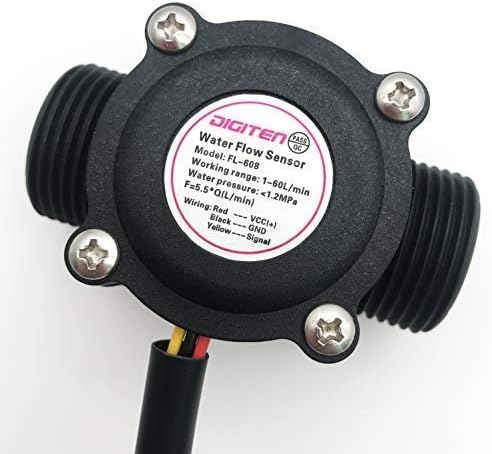
This model is designed for larger flow applications with a range up to 60 liters per minute. It includes a 1.2 meter cable for flexible sensor placement away from the main electronics.
We may earn a commission when you buy through this link, at no additional cost to you.
The G3/4 inch thread allows it to connect to larger pipes common in industrial or main residential water lines. It offers the capability to monitor high volume usage without replacing the pipe size.
However the rating is the lowest among options suggesting possible quality issues. Users should test thoroughly before final installation to ensure reliability in critical setups.
It is a necessary choice for high flow projects but handle with care during setup. The cable length is a valuable feature for managing wiring in complex installations.
Measures flows up to 60 liters per minute. This supports larger industrial or residential needs.
G3/4 inch thread fits bigger water pipes. This avoids bottlenecks in high volume systems.
We may earn a commission when you buy through this link, at no additional cost to you.
Selecting the right flow meter requires careful consideration of flow range, thread size, and material quality. This section details the most critical factors to ensure your sensor fits your specific project needs.
The flow rate range defines the minimum and maximum volume of water the sensor can measure accurately. Choosing a sensor with a range that matches your system prevents errors at low or high speeds.
Always check the min and max liters per minute rating before purchasing to avoid mismatched specifications.
Thread type such as NPT or BSPT must match your existing piping to ensure a leak free connection. Using the wrong thread size requires adapters which can introduce points of failure.
Confirm the pipe thread specifications on your water line before buying a sensor.
Materials determine if the sensor is safe for potable water or industrial fluids. ROHS compliant food grade plastics are safer for drinking water systems.
Look for ROHS certification to ensure health safety in your setup.
Different sensors operate at different voltages from 3.5V to 24V. Ensure your Arduino or power supply can support the sensor's specific working voltage.
Match the sensor voltage to your controller to prevent damage or unstable readings.
Some models come with a fixed short cable while others offer extended lengths. If the sensor is far from your controller a longer cable saves wiring effort.
Choose an extended cable model if your controller is distant from the water pipe.
Hall effect sensors provide digital pulse signals which are easy to read by microcontrollers. Ensure the output waveform matches your coding requirements for pulse counting.
Verify the output is a square wave pulse for compatibility with standard libraries.
Water pressure resistance indicates how much force the sensor can withstand before failing. Higher pressure is needed for mains plumbing versus low pressure systems.
Check the MPa rating to ensure it handles your system's water pressure safely.
Consider if the sensor will be used indoors or outdoors. Waterproof and heat resistant models are essential for outdoor or high temperature applications.
Select waterproof units for any environment exposed to humidity or heat.
Install the sensor in the correct flow direction as indicated by the arrow on the body. Reverse installation results in no signal output.
Secure the connections with appropriate seal tape to prevent leaks at the threads. Check for drips after initial water activation.
Calibrate the sensor by measuring a known volume of water. Use a bucket and timer to adjust your software scaling for accuracy.
The best choice is a sensor made with food grade plastic materials compliant with ROHS standards. DIGITEN models often meet these requirements ensuring safety for potable water systems.
Connect the red wire to 5V, black wire to GND, and the signal wire to a digital interrupt pin. Install a 10k pull up resistor for stable reading.
Ensure the flow direction arrow matches your water direction. Also check that the power supply is stable and the wire connections are secure.
Check the temperature resistance rating of the sensor. Some models are not rated for high heat and may fail with hot water flow.
Accuracy usually varies between 2% to 5% of the measured value. Calibration can improve precision for critical measurements.
Depends on usage and water quality but generally lasts for several years. Inspect for leaks or slow response times regularly.
YF-S201 models usually handle up to 1.75Mpa pressure. For higher pressures check specific industrial rated alternatives.
Yes most flow sensors work with Raspberry Pi using GPIO pins. Ensure the voltage levels match the Pi's logic levels.
The DIGITEN G1.5 model stands out for its wide flow range and perfect rating making it a versatile choice. Budget buyers will appreciate the NPT thread options that offer solid performance at a lower cost.
Prioritize thread size and flow range to match your specific plumbing needs. Safety standards like ROHS compliance are crucial for any drinking water projects.
Always verify current prices and stock status as availability can change quickly. Selecting the right sensor now ensures your project runs smoothly for years.