
Creality Otter Lite Basic 3D Scanner
5.0Editor score
0.05 mm high precision resolution
Portable lightweight design for easy transport
Full color texture mapping capabilities
This guide compares the top 3D scanners for reverse engineering based on precision, speed, and software compatibility to help you choose the right tool for
Reverse engineering requires precise digital capture of physical objects to recreate CAD models. A high-quality 3D scanner ensures accurate geometry and surface detail for manufacturing, prototyping, and quality control processes.
We evaluated ten leading scanners based on laser accuracy, scanning speed, software integration, and versatility. Each model was assessed for its ability to handle challenging surfaces like dark or shiny materials without extensive preparation steps.
Each selection highlights specific strengths for different workflows from industrial inspection to rapid prototyping. Note that specifications and availability may vary so always verify current details before making your final purchase decision today.
5.0Editor score

4.8Editor score

4.5Editor score
This comparison table outlines the key specifications and capabilities of each scanner to help you quickly identify which device best matches your specific reverse engineering requirements and workflow constraints.



The Revopoint MetroX Pro stands out as the top choice for professionals needing industrial-grade accuracy in reverse engineering workflows. With a single-frame precision of up to 0.01 mm and volumetric accuracy of 0.02 mm plus 0.04 mm per meter, it delivers the fidelity required for complex mechanical parts and assemblies.
We may earn a commission when you buy through this link, at no additional cost to you.
Its industrial-grade blue laser technology captures details flawlessly even on challenging surfaces like shiny metals or dark plastics without requiring scanning spray. The four scanning modes including 30 cross-line lasers and 15 parallel lines allow users to adapt to flat, feature-rich, or corner-heavy objects efficiently. Real-time streaming via the Revo Mirror app enhances workflow flexibility by letting you monitor scans on mobile devices without holding a laptop.
While the scanner itself is robust, users should note that advanced tools like Revo Design and Revo Measure are sold separately and only support Windows. This might limit flexibility for cross-platform teams. However, the core scanning performance and accuracy remain unmatched in this price range for detailed reverse engineering tasks.
Engineers and designers working on precision modeling or industrial measurement will find the MetroX Pro an invaluable asset. Its ability to handle various surface types and sizes with minimal prep makes it a reliable daily driver for professional reverse engineering projects where accuracy is non-negotiable.
The metrology-grade blue laser ensures every dimension is captured within tolerances critical for manufacturing verification and part replication workflows.
Real-time mobile streaming and automated turntable scanning reduce operator fatigue and increase throughput during complex multi-angle inspections.
We may earn a commission when you buy through this link, at no additional cost to you.
The MetroY Ultra is engineered for professionals who demand both speed and precision in their reverse engineering tasks. Its up to 90 FPS scanning speed allows rapid capture of large industrial components without sacrificing geometric accuracy, making it ideal for production line inspections or time-sensitive projects.
We may earn a commission when you buy through this link, at no additional cost to you.
This scanner offers unmatched flexibility with Wi-Fi 6 support, enabling wireless operation and real-time monitoring across PCs, tablets, or phones. The included 5500 mAh battery grip provides about 2.5 hours of stable power, perfect for field work or environments without easy power access. Additionally, its ability to scan outdoors in up to 100,000 lux ensures reliability in varied lighting conditions.
The main trade-off is the premium price tag which may not suit budget-conscious buyers. Also, like many high-end models, software support remains limited to Windows platforms. However, the productivity gains from fast wireless scanning and outdoor readiness justify the investment for active engineering teams.
If you need a scanner that combines metrology accuracy with portable performance, the MetroY Ultra delivers. Its no-spray scanning for dark or shiny surfaces further streamlines workflows, protecting delicate parts while maintaining high data fidelity for reverse engineering and quality inspection.
The battery grip and wireless Wi-Fi 6 enable uninterrupted scanning sessions away from desk setups without compromising accuracy.
At 90 FPS with 0.01 mm precision, it captures intricate details quickly, reducing downtime in fast-paced engineering environments.
We may earn a commission when you buy through this link, at no additional cost to you.
The EinScan Rigil redefines portability by offering a fully standalone scanning experience powered by onboard computing. With a 2.4GHz CPU, 32GB DDR5 RAM, and 1TB SSD, it processes scans internally, removing the need for constant PC connectivity. This makes it exceptionally convenient for field engineers or remote inspection tasks.
We may earn a commission when you buy through this link, at no additional cost to you.
Its hybrid Blue Laser and IR VCSEL technology provides ultra-precise 0.04 mm accuracy while capturing vibrant textures with a 5MP camera. The system handles dark or shiny metal surfaces without spray, ensuring high fidelity for automotive parts and sculptures. The 6.4-inch 2K AMOLED touchscreen enhances usability for on-the-go adjustments and settings.
While powerful, the Rigil comes at a premium price which may limit accessibility for small studios. Its weight is also slightly higher than lightweight alternatives, though the ergonomic design mitigates this. The inclusion of personal one-on-one online training adds significant value for users new to advanced 3D scanning.
For professionals needing maximum flexibility and processing power without tethering to a computer, the Rigil excels. Its complete package and ability to scan outdoors make it a robust choice for demanding reverse engineering scenarios in automotive and design applications.
Built-in computing allows full scanning workflow without laptops, freeing users from cables and power outlets during inspections.
Hybrid light sources ensure consistent results on challenging materials like polished metals or carbon fiber without extra prep.
We may earn a commission when you buy through this link, at no additional cost to you.
The Raptor Pro offers impressive versatility by scanning objects ranging from 5mm to 4000mm, making it suitable for everything from tiny components to automotive bodies. Its configuration of 22 crossed blue lasers and 7 parallel blue lasers ensures comprehensive coverage while maintaining high accuracy up to 0.02 mm for detailed reverse engineering.
We may earn a commission when you buy through this link, at no additional cost to you.
Built-in temperature compensation ensures stability in varying environmental conditions, while the 24-bit full-color capture restores true textures for lifelike digital replicas. The scanner integrates seamlessly with professional software like Geomagic, Rhino, and SolidWorks, supporting a smooth workflow from capture to final design.
While powerful, users should ensure their computer meets the recommended GPU requirements for optimal performance. The feature set is extensive, which may require time to master but ultimately provides deep control. This makes it ideal for teams needing reliable full-size adaptability in industrial design or medical applications.
For those seeking a scanner that handles diverse sizes without multiple devices, the Raptor Pro is a strong contender. Its ability to work across Windows and macOS further broadens accessibility, making it a flexible addition to any engineering or prototyping workflow.
From millimeters to meters, one device adapts to any object size, reducing inventory needs and workflow complexity.
High-fidelity color capture ensures visual details are preserved alongside geometry for comprehensive reverse engineering records.
We may earn a commission when you buy through this link, at no additional cost to you.
The INSPIRE 2 is designed for portability without compromising quality, weighing only 190g. This makes it easy to carry for field inspections or heritage preservation tasks. Its ability to scan in outdoor environments with up to 20,000 lux lighting ensures reliable performance even in semi-bright conditions.
We may earn a commission when you buy through this link, at no additional cost to you.
Using 11 infrared laser lines, it captures reflective or dark surfaces without spray, saving time on prep. The adjustable optical zoom helps focus on mixed-geometry surfaces to capture intricate details accurately. High-precision calibration ensures point cloud accuracy is boosted by 75% for consistent results.
While it lacks the extreme precision of industrial blue laser models, it excels for general reverse engineering and 3D printing prep. The included Revo Metro software offers intuitive tools, though advanced features like Revo Design require a separate purchase. This balance makes it great for designers needing portable flexibility.
If you need a lightweight scanner that can handle outdoor or varied lighting situations, the INSPIRE 2 fits the bill. Its combination of ease of use and solid accuracy makes it a practical choice for professionals prioritizing mobility in their workflow.
Built to handle ambient light up to 20000 lux, allowing scans in garages or shaded outdoor workspaces comfortably.
Adjustable optical magnification ensures small details are captured clearly without needing extreme close-range positioning.
We may earn a commission when you buy through this link, at no additional cost to you.
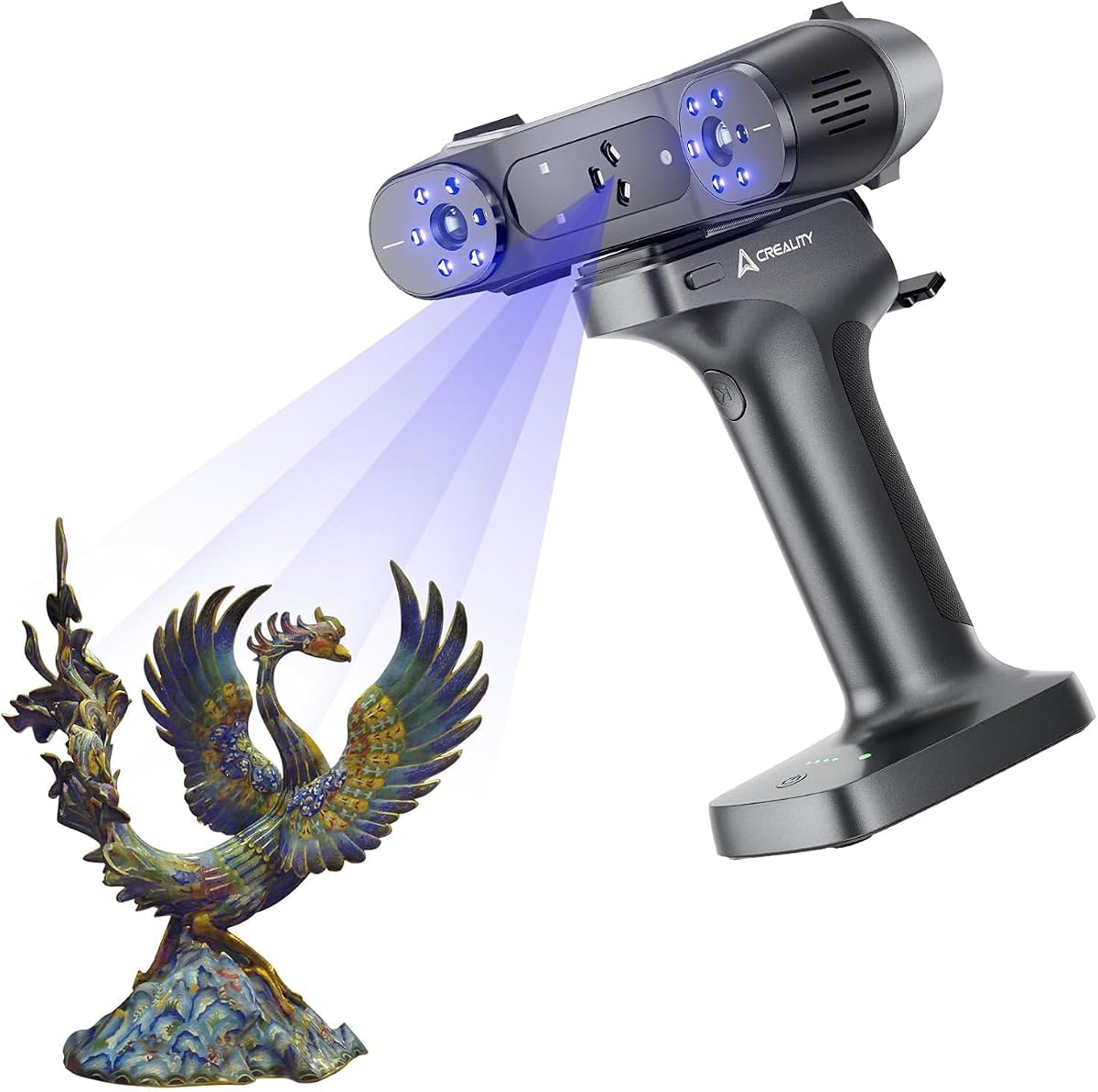
The Otter Lite Basic offers 0.05 mm resolution at an accessible price point, making it ideal for hobbyists and small businesses entering reverse engineering. Its dual-mode scanning supports close-range and long-range captures, providing flexibility for objects from 20mm up to larger sizes without extra hardware.
We may earn a commission when you buy through this link, at no additional cost to you.
Weighing just 235g, it is incredibly portable and includes a turntable, calibration board, and carrying case in the box. The RGB and infrared cameras capture true-to-life textures at up to 30 fps, exporting in standard formats like OBJ and STL. This simplifies the transition from scan to 3D printing or animation.
While it may not match the precision of higher-end industrial models, it offers excellent value for general design and prototyping. The user-friendly interface and LED indicators guide scanning distance effectively, reducing the learning curve for new users.
For those seeking a budget-friendly tool to kickstart reverse engineering projects, the Otter Lite Basic is a smart choice. Its portability and included accessories make it a complete solution for DIY enthusiasts or small workshops needing reliable digital capture.
Accessible pricing allows smaller teams to adopt 3D scanning technology without heavy upfront investments.
Included accessories mean you can begin scanning immediately without purchasing extra calibration or handling tools.
We may earn a commission when you buy through this link, at no additional cost to you.
The standard version of the MetroX Pro delivers the same high performance as its advanced variant, focusing on essential industrial needs. With single-frame precision of up to 0.01 mm, it captures every detail and dimension accurately for precision modeling and measurement tasks.
We may earn a commission when you buy through this link, at no additional cost to you.
Its four scanning modes, including cross-line and parallel lines, allow efficient capture of flat or complex surfaces without spray. The real-time streaming feature lets users monitor progress on secondary devices, enhancing workflow efficiency. The Revo Metro software provides intuitive editing and merging tools for seamless data preparation.
While it shares limitations like Windows-only support and paid add-on software, the core hardware reliability makes it a workhorse for consistent daily use. The 62-line full-field blue structured light enables marker-free scans of feature-rich objects at high speeds.
For engineers needing dependable accuracy without extra frills, this standard model is highly capable. Its ability to handle various object types and surface conditions makes it a versatile tool for reverse engineering and quality inspection in manufacturing environments.
Industrial-grade precision ensures repeatable results across multiple scanning sessions for reliable part replication.
Data transfers easily to CAD software, streamlining the transition from physical object to digital engineering model.
We may earn a commission when you buy through this link, at no additional cost to you.
The Creality Raptor Pro achieves metrology-grade accuracy of up to 0.02 mm with advanced blue laser technology, making it suitable for precise reverse engineering. Its configuration of 22 crossed and 7 parallel blue lasers allows rapid capture of medium to large objects while maintaining intricate detail.
We may earn a commission when you buy through this link, at no additional cost to you.
Users can scan from 5mm to 4000mm, adapting to anything from small components to car bodies. The CrealityScan app provides step-by-step tutorials and one-click model processing, simplifying the workflow for professionals and hobbyists alike. The outdoor-ready wireless capability ensures reliable performance in varied environments.
To get the best out of the scanner, a powerful computer with sufficient VRAM is recommended. While the software offers extensive tools, beginners might spend time learning the features. However, the results justify the effort for those needing detailed industrial data.
For comprehensive scanning needs without limiting object size, this model stands out. Its ability to handle diverse materials and sizes efficiently makes it a strong option for automotive, industrial design, or medical reverse engineering tasks.
One device covers the entire range from tiny parts to large vehicles, reducing the need for multiple scanners.
Robust app features and tutorials ensure that users can maximize the scanner's capabilities quickly and effectively.
We may earn a commission when you buy through this link, at no additional cost to you.
The Raptor X combines speed and wireless freedom with 34 cross laser lines and up to 0.02 mm accuracy. It captures medium to large objects rapidly, ideal for detailed reverse engineering. The Wi-Fi 6 support enables seamless data transfer with low latency and high transmission rates.
We may earn a commission when you buy through this link, at no additional cost to you.
Its large battery capacity allows for extended outdoor scanning sessions without frequent charging. The speckle matching 3D imaging eliminates the need for markers, simplifying setup. The face and body algorithm further enhances versatility for human scans or complex surfaces.
While it is heavier due to the battery, the convenience of wireless operation offsets this for many users. The unique face algorithm adds value for applications involving human forms, though it also excels at industrial parts. Ensure your computer meets system requirements for smooth operation.
For professionals prioritizing speed and mobility, the Raptor X is an excellent choice. Its balance of wireless flexibility and high accuracy makes it a versatile tool for automotive components or artifact preservation where efficiency matters.
High-speed Wi-Fi 6 keeps data flowing smoothly between scanner and host, reducing tethering issues.
The large battery ensures uninterrupted scanning for long durations, perfect for field or mobile inspections.
We may earn a commission when you buy through this link, at no additional cost to you.
The Raptor Pro 2 offers upgraded dual blue laser modes with 22 cross and 7 parallel lines for comprehensive coverage. Its 0.02 mm accuracy and high speed of 660,000 points per second make it suitable for detailed industrial inspection and reverse engineering tasks requiring speed and precision.
We may earn a commission when you buy through this link, at no additional cost to you.
Combining blue laser lines with infrared structured light, it scans objects from 5mm to 4000mm effortlessly. The software allows adjustable resolution and real-time preview, aiding post-processing. Compatibility with both Windows and macOS broadens its usability in mixed environments.
While the system requirements are demanding, the flexibility it offers justifies the investment for professional teams. The face and body mapping algorithm ensures no powder spray is needed even for black or metal surfaces, saving time in prep.
For those needing a balance of high precision and operational flexibility, the Raptor Pro 2 is compelling. It handles complex surfaces and diverse sizes effectively, making it a solid choice for automotive, artifact, and general engineering workflows.
Having both cross and parallel laser lines allows tailored scanning strategies for different object geometries and sizes.
Adjustable resolution settings let users balance detail and file size based on specific project needs.
We may earn a commission when you buy through this link, at no additional cost to you.
Choosing the right 3D scanner involves evaluating accuracy, scanning speed, software compatibility, and portability. This guide outlines the key factors to ensure you select a device that meets your specific reverse engineering requirements.
Accuracy refers to how close the scanned data is to the true dimensions of the object, while precision indicates consistency across multiple scans. For reverse engineering, look for scanners with single-frame precision of 0.02 mm or better to ensure reliable CAD model reconstruction. Industrial-grade scanners often offer volumetric accuracy that accounts for object size, ensuring large parts remain dimensionally correct.
Prioritize models with high metrology ratings if your work involves tight tolerances or manufacturing verification.
Faster scanning speeds reduce workflow time and increase productivity, especially for large objects or production inspections. Models offering 30 FPS or higher can capture data more rapidly, minimizing motion errors. High frame rates combined with multiple laser lines enable efficient coverage of complex surfaces in fewer passes.
Select a scanner with a frame rate that matches your object size and detail requirements to balance speed and data quality.
Seamless integration with CAD and reverse engineering software is essential for converting scanned point clouds into usable 3D models. Check if the scanner supports export formats like STL, OBJ, or PLY and works with your preferred tools such as Geomagic or SolidWorks. Also verify if the software is cross-platform or limited to Windows for your workflow.
Ensure the software ecosystem supports your specific engineering needs before purchasing the hardware to avoid compatibility bottlenecks.
Many objects to be reverse engineered have reflective, dark, or complex surfaces that challenge standard optical sensors. Look for scanners with blue laser technology or infrared structured light that can capture these materials without applying spray or markers. This capability saves prep time and maintains the integrity of delicate parts.
Choose a scanner that handles shiny or dark surfaces natively to streamline your inspection and capture workflow.
If you need to scan on-site or outdoors, a lightweight device with battery support is crucial. Wireless models with Wi-Fi connectivity and included battery grips allow operation without cables or power outlets. Consider the weight and ergonomics to ensure comfortable handling during extended sessions.
Prioritize portable models with long-lasting battery life for field work or environments without reliable power access.
Different scanners cater to specific size ranges from small components to large vehicles. Ensure the scanner's capture volume matches your typical project dimensions to avoid needing multiple devices. Some models offer dual modes for close-range and long-range scanning to accommodate varied needs.
Evaluate the minimum and maximum scan dimensions before buying to ensure the device fits your typical object sizes.
Scanners used outdoors or in varying lighting conditions require robust performance against ambient light. Models with high lux tolerance or dedicated outdoor modes ensure consistent results in non-lab environments. Temperature compensation algorithms also help maintain accuracy in fluctuating conditions.
Look for scanners with proven outdoor or variable light capabilities if you work outside controlled lab spaces.
Comprehensive customer support and training resources ease the onboarding process for new users. Some manufacturers include online training sessions or detailed tutorials to help you master scanning techniques. Ensure warranty terms and repair services are accessible to minimize downtime.
Select a brand with strong support offerings to guarantee long-term usability and problem resolution for your scanner.
Before scanning, calibrate the device using the provided board to ensure accuracy. Clean the scanner lens and ensure the object surface is free from dust or oils. For reflective parts, apply a matte coating if the scanner does not natively support high-gloss surfaces.
Hold the scanner steadily while capturing data, keeping the distance consistent with recommended values. For best results, scan in slow overlapping passes to ensure complete coverage without gaps. Use markers for feature-poor objects if required by your scanner software.
After scanning, clean the device with a soft dry cloth and store it in the protective case. Update firmware regularly to access new features and security patches. Proper maintenance extends the device's lifespan and maintains consistent performance over time.
Yes, many scanners provide built-in tools to view and align data, but converting the mesh to editable CAD models usually requires dedicated software. Basic viewers can check geometry but for engineering edits, integration with CAD tools is recommended.
High-end scanners with blue laser or infrared structured light can capture shiny or black surfaces without spray. Cheaper models may require coating to avoid reflections that confuse the optical sensors.
For functional parts requiring tight tolerances, look for scanners with at least 0.02 mm accuracy. Lower precision might be sufficient for visual or cosmetic models where fit is less critical.
Scan time depends on size and resolution but typically ranges from a few minutes for small parts to longer sessions for complex shapes. Faster scanners with higher frame rates reduce this duration significantly.
Yes, many modern handheld models are lightweight and battery-powered, designed for on-site inspections. Look for wireless Wi-Fi 6 support to enhance mobility without cables.
Most scanners support standard formats like STL and OBJ that are compatible with 3D printing slicers. Ensure your workflow includes proper mesh cleanup before printing.
Scanning software often requires decent GPU power for real-time processing and alignment. Check manufacturer recommendations for CPU, RAM, and VRAM to avoid performance issues.
Precision means consistent results across repeated scans while accuracy means how close results are to true dimensions. Both are vital for engineering but accuracy ensures the model fits actual specs.
We reviewed ten exceptional 3D scanners, each offering unique strengths for different reverse engineering needs. From the industrial accuracy of the Revopoint MetroX Pro to the portable flexibility of the INSPIRE 2, there is a device for every workflow and budget.
When selecting a scanner, prioritize accuracy and software integration if precision is critical for your projects. For field work or diverse surfaces, consider wireless and color capabilities to maintain efficiency without compromising data quality.
Always verify current availability and system requirements before purchasing as models evolve rapidly. With the right scanner, you can transform physical parts into accurate digital models with speed and confidence.