
ESP32-S3-Nano Microcontroller
5.0Editor score
Affordable Development Board
Integrated PSRAM and Flash
Arduino and MicroPython Support
Explore our expert guide comparing the top Arduino Nano ESP32 boards for IoT, embedded projects, and wireless connectivity in October 2026.
Finding the right microcontroller for your next project can be challenging. The Arduino Nano ESP32 offers a powerful blend of performance and connectivity for modern developers seeking efficient wireless solutions.
We analyzed ten top-rated boards based on processing power, wireless features, and ease of use. Our selection includes official releases and high-quality alternatives suitable for various skill levels.
Each pick highlights specific strengths like low power consumption or rich interfaces. Please note that product prices and availability may change frequently so verify current details before purchasing.
5.0Editor score

4.6Editor score

4.7Editor score
This side-by-side comparison highlights key specifications across all ten selected boards to help you quickly identify the best fit for your specific technical requirements and project goals.


The Arduino Nano ESP32 stands out as the top choice for developers who want official support and robust performance. It combines the power of the ESP32-S3 chip with the familiar Arduino ecosystem making it ideal for both beginners and pros.
We may earn a commission when you buy through this link, at no additional cost to you.
Its dual-core processor running at 240 MHz handles complex tasks like real-time data processing or voice recognition efficiently. The board also supports Human Interface Device profiles allowing you to create custom keyboards or mice easily.
While the price is slightly higher than third-party options the build quality and documentation justify the cost. You might find fewer GPIO pins compared to larger boards but this is acceptable for most compact IoT applications.
This board is perfect for anyone building smart home systems or wearables who values reliability and ease of use. We recommend it as the primary choice for serious projects requiring stable wireless connections.
With integrated Wi-Fi and Bluetooth 5.0 the board connects effortlessly to networks and cloud platforms enabling remote monitoring and control of your devices.
You can choose between the Arduino IDE or MicroPython allowing rapid prototyping and simpler code writing for educational or quick deployment scenarios.
We may earn a commission when you buy through this link, at no additional cost to you.
This board offers incredible value for money while delivering performance that matches much more expensive options. It features a powerful ESP32-S3R8 chip with substantial memory making it suitable for data-heavy applications without breaking the bank.
We may earn a commission when you buy through this link, at no additional cost to you.
The 8MB PSRAM and 16MB Flash allow you to store large datasets or complex libraries which is rare at this price point. Users also appreciate the ability to switch seamlessly between Arduino and MicroPython environments.
Although it is not an official Arduino product community feedback suggests reliable operation for most projects. The main drawback is that documentation may not be as detailed as official boards so you might need to rely on forums.
We highly recommend this for hobbyists or students looking to experiment with advanced features like IoT Cloud integration without spending a lot. It is the best budget option that does not compromise on core performance.
The generous onboard memory allows for handling larger projects and more complex code structures than typical microcontrollers in this price range.
You can monitor and control your projects remotely using the Arduino IoT Cloud app which adds significant value to this budget-friendly development board.
We may earn a commission when you buy through this link, at no additional cost to you.
The UNO R4 WiFi is a premium board that pushes the boundaries of what an Arduino can do. It pairs a Renesas microcontroller with an ESP32-S3 to deliver exceptional processing power and versatility for advanced applications.
We may earn a commission when you buy through this link, at no additional cost to you.
Features like the built-in 12×8 LED matrix and 12-bit DAC make it stand out for visual and analog projects. You can display status updates directly on the board without needing external screens which simplifies prototyping significantly.
The advanced analog capabilities such as the OP-AMP are rare in microcontrollers and useful for audio or sensor signal processing. While it costs more and is physically larger it offers functionality you simply cannot find elsewhere.
This board is ideal for professional developers or enthusiasts who need high precision and extra interfaces without extra wiring. If your project demands robust hardware features and a polished look this is the ultimate choice.
By combining two powerful chips the board handles real-time tasks and wireless communication simultaneously without sacrificing performance or responsiveness.
The built-in LED matrix allows for immediate visual output making it perfect for projects that require user interaction or status indicators.
We may earn a commission when you buy through this link, at no additional cost to you.
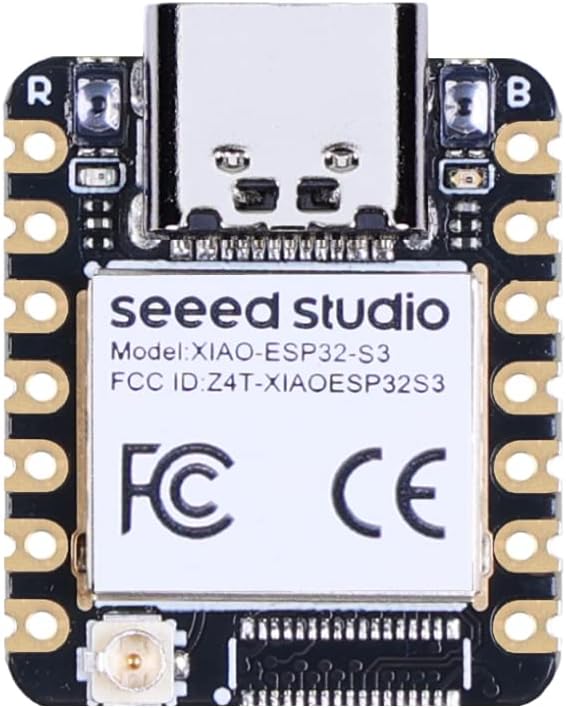
The XIAO ESP32S3 is designed for projects where space is at a premium. Its thumb-sized form factor makes it perfect for wearables or portable devices without sacrificing the power of the ESP32-S3 chip.
We may earn a commission when you buy through this link, at no additional cost to you.
Power efficiency is a major highlight with deep sleep modes consuming as low as 14 microamps. This extended battery life is crucial for remote sensors or wearables that need to run for months on a single charge.
The integrated lithium battery charge management simplifies power design significantly. However note that it relies on an external U.FL antenna for optimal range which adds a small step to the build process.
This board is perfect for makers working on robotics or health trackers where size and battery life matter most. We recommend it for anyone needing a small yet powerful wireless solution.
With multiple power consumption models and deep sleep capabilities this board ensures long operation times for battery-powered applications.
The tiny design allows embedding into tight spaces while maintaining all essential interfaces for sensors and communication modules.
We may earn a commission when you buy through this link, at no additional cost to you.
This board is built for specialized tasks like image and voice processing. The ESP32-P4 chip features hardware accelerators that handle JPEG decoding and video encoding efficiently which is rare in microcontrollers.
We may earn a commission when you buy through this link, at no additional cost to you.
The MIPI interfaces allow direct connection to cameras and displays making it great for vision-based projects. With 32MB PSRAM and robust security features it is ready for demanding applications like smart doorbells or industrial monitoring.
The RISC-V architecture offers a different computing paradigm that is gaining traction for open-source hardware enthusiasts. While powerful it might be overkill for simple IoT tasks and requires specific technical knowledge.
We recommend this for advanced users developing products that require heavy data processing at the edge. It bridges the gap between microcontrollers and more powerful embedded Linux systems effectively.
Dedicated image and voice processing interfaces accelerate tasks that would otherwise be too slow for general-purpose processors.
Features like secure boot and flash encryption ensure your devices are protected against unauthorized access or tampering.
We may earn a commission when you buy through this link, at no additional cost to you.
Getting three boards in one package makes this an excellent choice for teams or multiple prototypes. The ESP32-S3FH4R2 module ensures reliable Wi-Fi and Bluetooth performance with a dedicated antenna for better range.
We may earn a commission when you buy through this link, at no additional cost to you.
The castellated module design allows you to solder these directly onto custom carrier boards which simplifies production. Independent power settings give you granular control over consumption helping to optimize battery life.
These are best for projects where you need multiple nodes like a sensor network. The smaller size and lack of headers mean you might need to solder them which could be tricky for absolute beginners.
We suggest this for makers building larger systems or needing redundancy. The price per unit is very competitive offering solid performance for production or bulk testing needs.
The castellated edges allow for easy integration into custom PCBs which is great for moving from prototyping to manufacturing.
Independent power supply settings let you manage energy use across different components to extend battery life significantly.
We may earn a commission when you buy through this link, at no additional cost to you.
This kit is designed for those new to electronics and coding. It includes everything from sensors to displays so you can start building immediately without hunting for extra parts.
We may earn a commission when you buy through this link, at no additional cost to you.
The tutorials are detailed with clear circuit diagrams and code examples that guide you step by step. This structured approach reduces frustration and helps you understand the fundamentals of IoT development.
While the board itself is a standard ESP32 rather than the latest S3 version it still offers great connectivity and power. The bulk of components makes it large but that is manageable on a desk.
We highly recommend this for students or hobbyists starting their journey. It provides a solid foundation and confidence to move on to more advanced custom boards later.
The included guide covers everything from basic circuits to complex IoT applications ensuring you build skills progressively.
With diverse components you can build weather stations smart controllers and interactive gadgets to explore different domains.
We may earn a commission when you buy through this link, at no additional cost to you.
Security is paramount in IoT and this board excels with its built-in secure element. It ensures data encryption and secure authentication making it suitable for sensitive applications or commercial products.
We may earn a commission when you buy through this link, at no additional cost to you.
The built-in accelerometer adds value for motion detection without extra hardware. It is compact and easy to use with pre-soldered headers for quick prototyping.
Compared to newer ESP32-S3 boards it has lower processing speed but it is efficient for standard sensor data tasks. The official support guarantees long-term compatibility and stability.
We recommend this for projects where data privacy is critical. It is a reliable choice for smart home devices or industrial sensors needing secure connections.
The ATECC608A secure element provides hardware-level encryption ensuring your data remains safe from interception.
A built-in accelerometer simplifies motion-based projects by eliminating the need for external sensor wiring.
We may earn a commission when you buy through this link, at no additional cost to you.
This classic board remains a staple for many projects due to its reliability and widespread documentation. It uses the trusted ESP-WROOM-32 module which has been tested in countless applications.
We may earn a commission when you buy through this link, at no additional cost to you.
The integrated RF components ensure stable signal performance without extra parts. It supports standard Wi-Fi and Bluetooth 4.2 which is sufficient for many basic smart devices.
Compared to S3 boards it lacks some modern features like AI acceleration but it is still powerful for general tasks. The three-pack offers great value for teams or multiple builds.
We suggest this for users who prefer established hardware with abundant community support. It is a safe and cost-effective choice for standard IoT automation.
The ESP32 architecture is well-documented and supported ensuring you can find resources for almost any problem.
Ultra-low power modes and reliable networking make it a dependable option for battery and mains powered systems.
We may earn a commission when you buy through this link, at no additional cost to you.
This board brings the convenience of USB-C to the classic ESP32 design. It simplifies connectivity and reduces cable clutter which is a welcome upgrade for modern setups.
We may earn a commission when you buy through this link, at no additional cost to you.
Over-the-air updates allow you to deploy firmware changes remotely saving time during development. The dynamic clock scaling helps optimize performance and energy use effectively.
While the Bluetooth is 4.2 not the newer 5.0 it still works well for most tasks. The three-pack ensures you have spares or multiple nodes available for testing.
We recommend this for users wanting a modern interface on a reliable board. It is an excellent choice for prototyping projects that need easy updates and connections.
The USB-C port makes plugging in faster and more durable which is ideal for frequent use and testing.
OTA support means you can update devices in the field without physical access which is vital for large deployments.
We may earn a commission when you buy through this link, at no additional cost to you.
Choosing the right board involves balancing performance, connectivity, and cost. Below are key factors to consider before making your decision.
Look for boards with dual-core processors like the ESP32-S3 or RISC-V variants for better multitasking. Higher clock speeds up to 240MHz ensure smoother handling of complex algorithms and data processing.
Prioritize boards with modern architectures if you need to run AI models or process audio and video signals efficiently.
Ensure the board supports the Wi-Fi and Bluetooth versions your project requires. Newer models offer Bluetooth 5.0 or 5.1 for better range and power efficiency compared to older 4.2 versions.
Consider boards with integrated antennas or U.FL connectors if you need robust signal strength for remote applications.
Check for PSRAM and Flash memory sizes especially if your code or data set is large. Boards with 8MB PSRAM or more allow for richer applications without external memory.
Select models with ample Flash if you need to store configurations or local data without relying on a cloud connection.
Verify that the board works with your preferred coding language like C++ via Arduino IDE or Python via MicroPython. Official boards usually have better driver support and tutorials.
Community support is vital so choose models with active forums and documentation to help you debug issues quickly.
If your project involves wearables or tight spaces look for compact options like the XIAO ESP32S3. Standard Nano sizes are easier to breadboard but may not fit in small enclosures.
Consider if the board needs to be soldered onto a carrier or if it comes with headers for direct connection to sensors.
For battery-powered devices check for deep sleep modes and power management features. Some boards offer battery charge support which simplifies the design for portable gadgets.
Low power consumption extends battery life significantly so prioritize energy-efficient models for remote sensors.
Some boards offer extra features like DACs for audio or built-in displays which reduce the need for external components. Interfaces like CAN or Qwiic simplify connecting industrial sensors or I2C devices.
Evaluate if you need specialized ports like USB OTG or Ethernet for more advanced industrial or networking applications.
Official boards cost more but offer reliability and support while clones often provide better value for money. Multi-packs can be cost-effective if you need multiple units for testing or distribution.
Balance the budget with the long-term benefits of quality hardware to avoid replacements or failures down the line.
Begin by installing the latest drivers and Arduino IDE on your computer to ensure proper communication with the board. Connect the board via USB-C and select the correct port in the IDE for uploading code.
Protect the board from moisture and extreme temperatures to extend its lifespan. Use a stable power source and avoid connecting high-voltage components directly to GPIO pins without protection circuitry.
Regularly back up your sketches and update firmware to benefit from security patches and new features. Clean the pins gently with a soft brush if dust accumulates to maintain reliable connections.
The Arduino Nano ESP32 offers official Arduino support with easier setup and enhanced software libraries. It also typically features newer hardware like the ESP32-S3 for better performance and USB-C connectivity compared to older models.
Yes most of the ESP32-S3 compatible boards support MicroPython for easier scripting. This allows you to run Python code directly on the microcontroller without needing complex C++ environments.
Many boards come with onboard ceramic antennas which work well for typical ranges. Some larger models offer U.FL connectors if you need to attach a larger external antenna for extended distance.
Yes all official Arduino Nano ESP32 boards are fully compatible with the Arduino IDE. You just need to install the ESP32 package or specific board support files to start programming.
The Seeed Studio XIAO ESP32S3 is excellent due to its low sleep current and integrated battery charging. The Waveshare ESP32-S3 Mini also offers flexible power settings to help conserve energy.
You can use them for prototypes but consider board quality and certifications for commercial use. Official boards often have better documentation and support for compliance which is crucial for mass production.
Our top picks include the Arduino Nano ESP32 for overall performance and the ESP32-S3-Nano for budget-friendly options. Each board offers unique strengths suited to different project needs and expertise levels.
Prioritize connectivity and processing power based on your specific application requirements. Security features and power management should guide your choice if you are building battery devices or sensitive applications.
Remember that prices may change so check current listings before buying. Select the board that best aligns with your long-term goals to ensure a successful development experience.