
Korg Volca Drum
4.4Editor score
Compact portable design
16-step sequencer
DSP synth engine
This guide compares the top digital drum machines for musicians and producers, evaluating sound quality, workflow, and features to help you choose the perfect
Digital drum machines have revolutionized music creation by providing portable, versatile rhythm tools for producers and performers. A good machine offers rich sound libraries, intuitive sequencing, and reliable connectivity to fit any workflow.
We compared ten leading models based on sound engine quality, sequencing flexibility, portability, and user feedback. Each product was evaluated for its ability to deliver professional results in studio and live settings.
Each pick highlights unique strengths and ideal use cases to help you find the right match for your needs. Please note that prices and availability may change frequently, so verify current details before purchasing.
4.4Editor score

4.8Editor score

4.4Editor score
This side-by-side comparison highlights the core specifications and unique strengths of each digital drum machine to help you make an informed decision based on your specific musical needs.


The Roland TR-8S Rhythm Performer stands out as the top choice for producers seeking authentic heritage combined with modern production techniques. With a rating of 4.8 stars, it delivers every sound from the most sought-after TR drum machines alongside customizable effects and sample import options.
We may earn a commission when you buy through this link, at no additional cost to you.
Its hybrid sound creation allows users to build kits entirely from samples or mix them with authentic TR sounds. The TR-8S features detailed circuit-models of the 808, 606, 909, 707, and 727. Users can adjust decay, tuning, sample start points, speed, and direction for precise manipulation.
While the workflow is powerful, the sheer number of features can be overwhelming for newcomers. The interface requires time to master fully. However, the free TR-EDITOR software provides a graphical interface that simplifies organizational tasks and expands creative possibilities significantly.
This machine is ideal for live performers and studio producers who demand performance-ready kit storage. Both instrument and master effects are saved with each kit. If you need a versatile drum machine that bridges vintage tones with modern flexibility, the TR-8S is the definitive solution.
Every sound from classic machines is included with detailed circuit-models allowing deep customization for unique sonic identities.
Import your own mono or stereo sounds using the SD card slot to expand beyond preset samples and create original kits.
We may earn a commission when you buy through this link, at no additional cost to you.
The Korg Volca Drum offers an affordable entry point into professional drum synthesis without compromising on sound quality. Rated 4.4 stars, this digital percussion synthesizer features a built-in speaker and a 16-step sequencer for intuitive and flexible music programming on the go.
We may earn a commission when you buy through this link, at no additional cost to you.
Its six-part DSP synth engine provides a wide range of drum sounds enhanced by a waveguide resonator that adds rich resonances. The Active Step function lets you replace steps for each part adding variety. A Slice function finely divides steps to allow drum-rolls and intricate rhythms.
The small form factor means buttons can be tight to press during intense sessions. Polyphony is also limited compared to larger units. These constraints are acceptable given the price point and its purpose as a portable idea generator or supplementary tool.
Perfect for electronic musicians needing a budget-friendly option for studio and live settings. The convenience of a built-in speaker makes it ideal for quick jams. If you want high-quality drum sounds without a major investment, the Volca Drum delivers exceptional value.
Its small size and built-in speaker allow for on-the-go music creation wherever inspiration strikes without needing extra gear.
Replace steps for each part to add variety and complexity to your patterns instantly without rewriting entire sequences.
We may earn a commission when you buy through this link, at no additional cost to you.
The Elektron Digitakt II is a powerhouse for advanced users seeking deep sound design capabilities. Rated 4.4 stars, it features 16 audio tracks ready for stereo or mono samples or MIDI. The 128-step Elektron sequencer supports complex compositions with ease through its robust song mode.
We may earn a commission when you buy through this link, at no additional cost to you.
Users benefit from 3 assignable LFOs per track and effects like delay, reverb, chorus, bit reduction, sample reduction, and overdrive per track. The unit includes swappable filters with options like base-width, multi-mode, low pass, comb, EQ, or legacy LP/HP to shape sound precisely.
The complexity of the interface can deter those new to hardware sequencing. Additionally, the lack of an internal speaker requires external monitoring. These trade-offs are acceptable for professionals who need granular control and a powerful standalone sampler in a compact chassis.
Best for producers who want complete control over every parameter of their drum tracks. With 4 trig modes and a Euclidean sequence generator, it supports unique rhythmic patterns. If you prioritize sound design depth over ease of use, the Digitakt II is unmatched.
Every track is ready for stereo or mono samples or MIDI allowing for layered and complex drum arrangements effortlessly.
Access a variety of filters including multi-mode and low pass to shape your drum sounds with precision and character.
We may earn a commission when you buy through this link, at no additional cost to you.
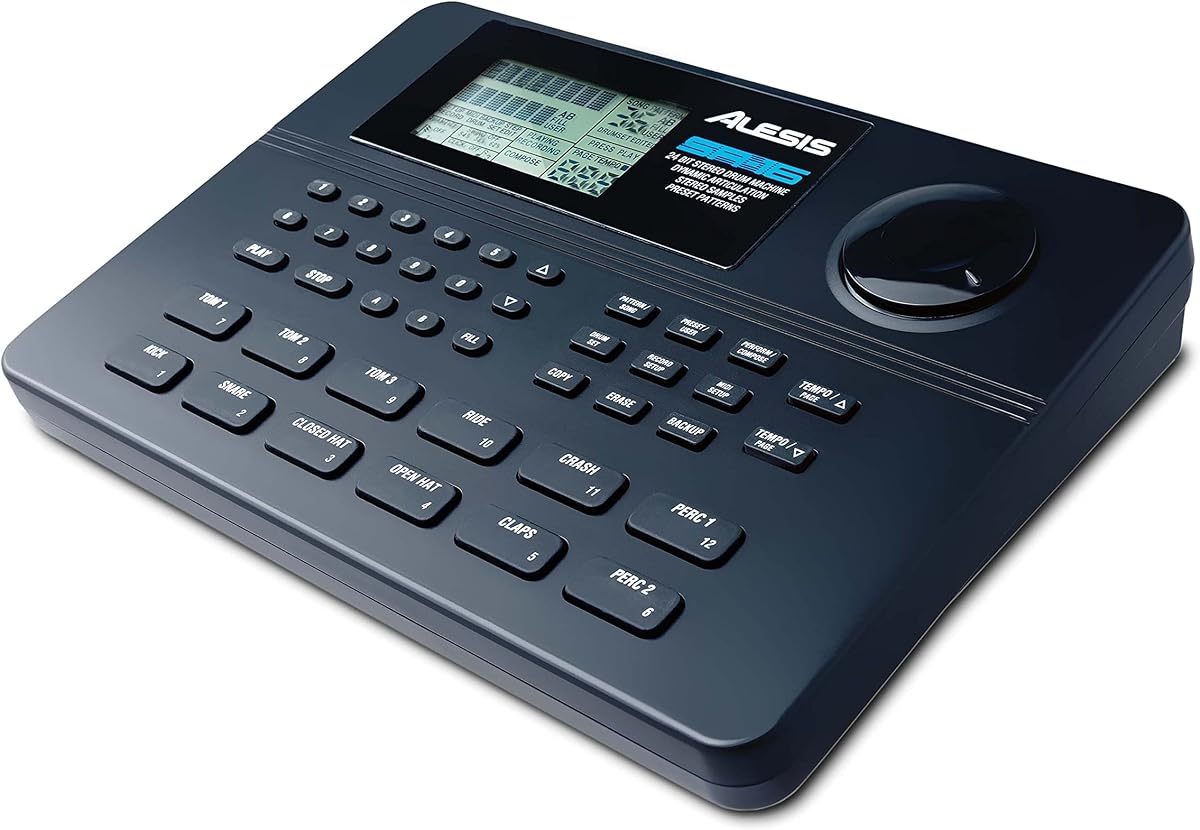
The Alesis SR-16 is a studio icon that has served songwriters and live performers for decades. With a rating of 4.4 stars, it includes 233 professional sounds and built-in digital effects for added realism. It is powered by Alesis exclusive Dynamic Articulation for realistic performance.
We may earn a commission when you buy through this link, at no additional cost to you.
Seamless MIDI connectivity allows use with keyboards, computers, DAWs, and electronic drum kits. The machine features 4 stereo pairs outputs and 2-function footswitch jacks for start/stop and count/A/B/fill. Production-ready features include sound stacking, step editing, and stereo samples with reverb and ambience.
While it lacks modern sampling options found in newer models, its reliability and sound quality remain compelling. The interface is less intuitive than touchscreen units. However, for those accustomed to its workflow, it offers a straightforward and dependable experience for standard drum programming.
Ideal for musicians who value classic sounds and robust MIDI integration. The 12 velocity sensitive pads and 50 preset plus 50 user drum kits provide ample versatility. If you need a standalone machine with proven reliability, the SR-16 continues to be a strong contender.
Access 233 professional sounds included with built-in digital effects powered by Dynamic Articulation for realistic results.
Utilize 4 stereo pairs outputs and footswitch jacks for comprehensive control during live performances and studio sessions.
We may earn a commission when you buy through this link, at no additional cost to you.
The Akai Professional MPC Sample brings the iconic MPC workflow into a compact portable format ideal for beatmakers and finger drummers. Rated 4.8 stars, it delivers complete standalone operation with a battery-powered design and built-in speaker. You can record, edit, and playback anywhere without a computer.
We may earn a commission when you buy through this link, at no additional cost to you.
It features 16 responsive MPC pads and a 2.4 inch full-color display for an intuitive creative workflow. Instant inspiration comes from over 100 factory kits and Instant Sample Chop Mode. Powerful onboard FX include four internal FX processors with dedicated knob control and 60 effect types.
While the workflow is streamlined, the battery requires separate purchase or careful management. Some advanced features of larger MPCs are absent to maintain portability. These compromises are acceptable for a device designed specifically for portability and quick idea capture without computer dependency.
Perfect for new and experienced beatmakers seeking a portable production hub. The comprehensive I/O allows integration into live rigs and home studios. If you want a lightweight tool that captures the spirit of MPC sampling with modern connectivity, the MPC Sample is an excellent choice.
Battery-powered design with built-in speaker enables recording editing and playback anywhere without computer or DAW required.
Comes loaded with over 100 factory kits and intuitive chopping workflow for a fast journey from raw sound to finished groove.
We may earn a commission when you buy through this link, at no additional cost to you.
The Teenage Engineering EP-133 K.O. II is designed to get you from idea to track faster than ever with a unique workflow. Rated 4.7 stars, it features double the memory of the original and a fully reworked sequencer. The sequencer engine provides a fast way of building up beats using 4 groups x 99 patterns.
We may earn a commission when you buy through this link, at no additional cost to you.
It allows you to instantly swap patterns per group and experiment with different combos. The commit button helps you freeze a point in time and move on adding a verse or break in real time. You can add stereo effects and punch-in effects fast using the multifunctional fader.
The small screen and limited manual controls can make detailed editing slower compared to larger units. However, the workflow prioritizes speed and experimentation over precision editing. This trade-off encourages creativity by allowing users to focus on the big picture and flow.
Best for electronic musicians who value speed and experimentation over detailed editing. The built-in microphone allows sampling sounds around you easily. If you want a portable machine that inspires fast beat creation and performance tweaking, the EP-133 K.O. II is a standout tool.
The sequencer engine provides an intuitive way to build beats using pattern groups for instant experimentation and flow.
Record sounds around you or resample your voice and synths using the internal microphone for immediate sampling.
We may earn a commission when you buy through this link, at no additional cost to you.
The KORG drumlogue offers a threefold hybrid design combining Analog, Digital, and Multi Engine for deep sound creation. With a rating of 3.6 stars, it features front panel knobs for instantly controlling tuning and attenuation. Dedicated volume knobs for each part simplify live mixing without diving into menus.
We may earn a commission when you buy through this link, at no additional cost to you.
Its powerful sequencer supports 11 parts and 64 steps allowing songs to be created by combining Loop and Chain functions. Customizable effects include Reverb and Delay per part plus Master and third party effects that can all be used simultaneously. Connectivity includes stereo plus 4 assignable outputs.
The engine rating suggests some users find the interface complex or initial sounds less polished. The open-source oscillator options add depth but require technical knowledge. For those willing to invest time, these complexities offer unmatched customization for unique sonic textures.
Ideal for sound designers who want hardware with open-source flexibility. The audio input allows processing other instruments through the drumlogue’s effect chain. If you need a hybrid machine with extensive customization and strong connectivity, the drumlogue offers unique capabilities despite the learning curve.
Instantly control tuning and attenuation of bass drums snares toms and other instruments for fast live mixing.
Use Reverb and Delay per part plus Master effects simultaneously for rich sound design without routing external processors.
We may earn a commission when you buy through this link, at no additional cost to you.
The Behringer LM DRUM bundle includes headphones and a cable for immediate setup and creative exploration. Rated 5.0 stars, it offers 16 voices of sampling architecture delivering rich and dynamic drum sounds for professional-grade productions. It includes a powerful 64-step drum sequencer supporting poly-meter and step-repeat.
We may earn a commission when you buy through this link, at no additional cost to you.
It features comprehensive connectivity including MIDI In/Out/Thru, USB 2.0 Type B, and Sync In/Out for seamless integration. The unit has multiple audio outputs and an audio input for flexible routing. A built FX bus features Wave Designer and dual-mode Analog Filter with per voice assignment.
While the sound quality is praised, the workflow is less flexible than advanced units. Customization depth is moderate compared to open-engine machines. However, the bundle value and robust build quality make it attractive for musicians who need reliable performance without complex setup.
Best for beginners or performers needing a straightforward drum machine with good connectivity. The 16 independent analog outputs allow multi-track recording for external processing. If you want a reliable machine with included accessories and solid audio quality, the Behringer LM DRUM is a strong option.
Bundle includes headphones and cable for immediate setup and creative exploration without extra purchases.
Comprehensive connectivity including MIDI USB and Sync allows seamless integration into any studio or live setup.
We may earn a commission when you buy through this link, at no additional cost to you.
The Yamaha DTX Multi Pad offers a massive library of sounds with 1,061 drum, percussion, and effects sounds plus 216 keyboard sounds. Rated 4.3 stars, it features a Mute/Layer function for complex sound stacking. The built-in Sequencer and Preset Loops allow for quick pattern creation.
We may earn a commission when you buy through this link, at no additional cost to you.
It includes 64MB Flash-ROM for user samples allowing customization beyond presets. The device is designed for performance with easy access to sound sets and effects. While larger than compact units, it provides a wide palette of sounds suitable for diverse musical genres.
The size limits portability compared to smaller models. The workflow is straightforward but lacks the deep sequencing of specialized drum computers. However, for musicians needing a broad sound library and keyboard integration in one unit, it offers substantial utility.
Best for performers who need a wide variety of sounds beyond drums. The sequencer loops speed up workflow during live shows. If you prioritize sound variety and ease of use over extreme portability, the DTX Multi Pad provides a reliable and versatile option.
Access 1061 drum percussion effects sounds plus 216 keyboard sounds for a broad musical palette.
Store custom samples in 64MB Flash-ROM to expand your sound options beyond factory presets.
We may earn a commission when you buy through this link, at no additional cost to you.
The Singular Sound BeatBuddy is the first-ever drum machine in a pedal format allowing musicians to control beats live with physical foot controls. Rated 4.5 stars, it includes 200+ songs across 24 genres and 10 ultra-realistic drum kits. You can store 3.2 million songs and 300 drum sets.
We may earn a commission when you buy through this link, at no additional cost to you.
It features a visual metronome on the LCD screen to help improve rhythm and master complex time signatures. The hands-free design is perfect for solo performers and live looping guitarists. Compact and durable, it consumes only 100mA power making it ideal for gigs.
Operating solely by foot requires practice to master transitions between fills and breaks. Deep editing is less convenient than a keyboard interface. However, the convenience of pedal control for live performance outweighs these limitations for many touring musicians.
Best for solo performers and guitarists needing reliable backing tracks. The analog feel mimics a real drummer well. If you want a compact tool that delivers professional sound and hands-free control for live sets, the BeatBuddy is the ideal choice.
Control beats live and in real time with physical foot controls perfect for solo performers and live looping.
The LCD screen visual metronome helps improve rhythm and master complex time signatures effortlessly during practice.
We may earn a commission when you buy through this link, at no additional cost to you.
Selecting the right digital drum machine involves balancing sound quality, workflow, connectivity, and budget. Understanding these factors ensures you invest in a tool that supports your creative goals.
Look for machines that offer both authentic samples and synthesis options. A hybrid engine often provides the best balance of realism and customization. Check for included sound libraries and whether you can import your own samples to expand sonic possibilities.
Prioritize models with detailed sound shaping tools like filtering and amplitude control for professional results.
Evaluate the step count and track limits. Complex compositions require more steps and tracks to avoid constant looping. Features like swing, groove, and conditional probability allow for more humanized rhythms that avoid robotic repetition.
Choose a sequencer that matches your workflow style whether step-based or real-time recording.
If you perform live, a compact unit with battery power is essential. Larger units often offer better controls but are harder to transport. Consider the physical size of the interface and whether keys or pads are suitable for your style of play.
Select a device that fits easily into your backpack or gig bag.
Ensure the machine has the necessary inputs and outputs for your setup. MIDI is essential for syncing with other hardware or software. Audio outputs should match your mixer or interface type to avoid adapter issues during critical sessions.
Verify USB and Sync options to integrate with your existing studio infrastructure.
Determine how much you can spend on a primary production tool. High-end models offer depth but require time to learn. Mid-range options often strike a balance between features and ease of use. Always check if bundles include necessary accessories to save money.
Invest in a model that offers the features you need most right now.
Consider the learning curve of the interface. Touchscreens or clear buttons can speed up workflow compared to menus. Read user feedback regarding menu diving and frustration levels. A machine that feels intuitive will be used more consistently.
Choose a device that supports your creative flow without technical friction.
Check if the manufacturer offers firmware updates or expansion packs. Long-term support ensures your machine stays current with trends. Compatibility with community-created sounds or patches can significantly extend the device's lifespan.
Select models with a strong community or developer ecosystem for longevity.
Battery life is critical for portable use. Units that support USB power are advantageous for modern setups. Ensure you have enough power to last through your longest practice or performance session.
Verify power requirements to avoid interruptions during use.
Begin by connecting the device to your audio interface using the appropriate output cables. Ensure all power sources are stable to prevent data loss during saving. If using MIDI, connect your computer or keyboard to sync timing accurately for live sets.
Start by exploring factory kits and saving custom variations immediately. Adjust decay and tuning on individual sounds to match your specific mix. Use the sequencing functions to build patterns in small increments before combining them into full song structures.
Store your device in a dry, cool place when not in use to protect sensitive electronics. Avoid exposing it to direct sunlight or excessive dust. Keep firmware updated to access new features and bug fixes provided by the manufacturer for optimal performance.
Most modern digital drum machines use standard MIDI and USB connections which make them compatible with major DAWs. Always check if your specific model supports the transport protocols used by your software. Some units offer dedicated drivers for enhanced integration with popular systems.
Many premium and mid-range models allow you to import your own samples via SD cards or USB. Check the memory limits and supported file formats before purchasing. This feature allows you to build entirely custom kits tailored to your genre.
A drum machine focuses on rhythmic patterns and drum sounds while a sampler can record any sound. Some hybrid models combine both to give you full control over percussion and melodic elements. The choice depends on whether you need strict rhythmic control or broader sound options.
Most standalone digital drum machines operate independently without a computer. You can create, record, and playback tracks directly on the hardware. However, a computer may be needed for deep editing or transferring large sample libraries efficiently.
Use MIDI clock or DIN MIDI connections to sync with other hardware synthesizers or sequencers. Some units support word clock or audio sync for precise alignment. Ensure all devices are set to the same tempo and clock source to maintain timing consistency.
The learning curve varies by complexity. Basic models offer simple step sequencing that beginners can master quickly. Advanced units may require time to learn parameter locks and complex modulation. Starting with factory kits helps build confidence before diving into custom design.
We reviewed ten top models ranging from the budget-friendly Korg Volca Drum to the premium Elektron Digitakt II. Each machine offers distinct strengths in sound design, workflow, and portability to suit different needs.
When choosing, prioritize sound quality and interface comfort based on your experience level. Ensure connectivity matches your studio or live setup to avoid compatibility issues. Select a device that grows with your skills rather than limiting your creative output.
Please verify current prices and availability before purchasing as they may change. Investing in a model that aligns with your specific workflow will deliver the best return on your creative journey.