
Askar 71F Flat-Field Telescope
4.9Editor score
Lightweight 2.5kg OTA
Quadruplet air-spaced
Integrated field flattener
This guide compares the top 10 apochromatic refractors for astrophotography and visual astronomy based on optics, portability, and user ratings.
Apochromatic refractors are elite telescopes designed to eliminate color fringing and deliver sharp, high-contrast views. They use special low-dispersion glass to correct chromatic aberration, making them ideal for both visual observation and serious astrophotography enthusiasts seeking pristine image quality.
We evaluated ten leading apochromatic refractor models based on optical design, aperture size, build quality, and user feedback. Our analysis focuses on triplet and quadruplet optics, focal ratios, and accessory compatibility to help you find the perfect scope for your specific observing goals and budget constraints.
Each selection below highlights key strengths, technical specifications, and real-world performance notes to guide your purchase decision. Prices and availability fluctuate frequently, so please verify current details on the product pages before finalizing your order to ensure you get the best value available today.
4.9Editor score

4.5Editor score

The following table provides a side-by-side overview of all ten selected apochromatic refractors, highlighting their core optical specifications, mounting compatibility, and unique design features to assist in quick comparison and selection.




This SVBONY SV550 AP0 telescope stands out as a premier choice for astronomers seeking high-quality apochromatic performance. With its triplet ED glass optics and air-spaced design, it effectively eliminates color fringing to deliver bright and high-contrast images ideal for observing celestial bodies.
We may earn a commission when you buy through this link, at no additional cost to you.
The use of S-FPL51 low-dispersion glass combined with correction glass ensures that blue-edge chromatic aberration is virtually eliminated. The magnesium alloy dual-speed focus mount reduces weight and vignetting, making it highly compatible with full-frame cameras for serious astrophotography sessions.
While the scope is lightweight and portable, users should note it is sold as an OTA requiring a separate mount and accessories. The included extinction measures inside the lens barrel help prevent stray light, but you will need to source your own eyepieces for visual observing.
For those ready to invest in a versatile instrument capable of both visual observation and photography, this telescope offers outstanding optical performance. Its balanced design and premium materials make it a top recommendation for enthusiasts aiming to capture detailed deep sky objects.
The triplet apochromatic structure effectively solves blue-edge aberration common in single-ED scopes, ensuring sharp star points across the field of view.
The 2.5-inch focuser and extinction barriers minimize vignetting and stray light, providing the clean optical path required for professional astrophotography results.
We may earn a commission when you buy through this link, at no additional cost to you.
The Explore Scientific ED80 Essential Series delivers brilliant views through its combination of genuine FCD1 HOYA extra-low dispersion glass and proprietary enhanced multi-layer coatings. This optical setup produces excellent views filled with stunning details that appeal to both visual observers and photographers.
We may earn a commission when you buy through this link, at no additional cost to you.
Designed with portability in mind, the 480mm focal length and retractable dew shield make this scope perfect for spontaneous stargazing. The front cell features push-pull adjustments for precision collimation, ensuring you can achieve the tightest stars possible for optimal image quality.
Although it is a highly capable instrument, the ED80 is slightly heavier than some competing models which might require a sturdier mount. The USA-based support provides peace of mind, but the premium glass and construction contribute to a higher cost compared to budget options.
If you prioritize optical purity and precise collimation control, this refractor is a worthy investment. It excels at capturing deep sky targets like nebulae and star clusters with clarity that justifies its reputation among astronomy enthusiasts.
FCD1 HOYA glass offers superior dispersion characteristics compared to standard ED glass, resulting in minimal color fringing even at high magnifications.
Push-pull adjustments on the front cell allow for fine-tuning alignment, ensuring optimal optical performance for critical astrophotography work.
We may earn a commission when you buy through this link, at no additional cost to you.
This SVBONY SV550 bundle stands out for including the SV209 Field Flattener which corrects field curvature for deep sky astrophotography. The 1.0X flattener ensures a flat field of view making it compatible with both half-frame and full-frame cameras for versatile imaging.
We may earn a commission when you buy through this link, at no additional cost to you.
The focusing seat is made of magnesium alloy reducing weight by over twenty percent compared to aluminum alternatives. This lightweight design combined with the 180mm dovetail plate makes the telescope stable and easy to carry during spontaneous observation sessions.
While the bundle offers great value with the included flattener, users may need to adjust the focus seat periodically to prevent loosening. The package includes necessary adapters but does not come with eyepieces so you will need to source those separately for visual use.
For astrophotographers wanting a ready-to-use imaging setup without buying components separately this bundle is an excellent choice. The included flattener significantly improves edge performance allowing you to capture sharp stars across the entire image frame immediately.
The SV209 flattener corrects field curvature ensuring sharp stars across the entire sensor especially for large format cameras.
Magnesium alloy components reduce weight significantly making transport easier without compromising stability on standard telescope mounts.
We may earn a commission when you buy through this link, at no additional cost to you.
The SVBONY SV550 122mm APO refractor features a generous aperture that gathers more light for clear and detailed images of deep sky objects. It adopts a FPL-51 triplet apochromatic lens structure which contains one piece of ED glass to greatly reduce chromatic aberration and enhance sharpness.
We may earn a commission when you buy through this link, at no additional cost to you.
Designed as a compact travel telescope it includes a convenient carrying handle and a dovetail base that makes installation and transport easy. The large aperture provides higher limiting magnitude allowing you to observe fainter deep sky objects that smaller scopes cannot easily reach.
While the larger aperture brings more light it also increases weight compared to 80mm models requiring a sturdier mount for stability. The included guide scope bracket allows for easy installation but you will need to purchase a guide camera separately for autoguiding.
If you need maximum light gathering power in a portable package this telescope delivers premium performance. The combination of large aperture and high-quality triplet optics makes it ideal for serious deep sky photography and observation.
The 122mm aperture gathers significantly more light allowing visibility of fainter deep sky objects and shorter exposure times.
Convenient handle and optimized base design make moving this larger aperture telescope easier during transport and setup.
We may earn a commission when you buy through this link, at no additional cost to you.
The Askar 71F Flat-Field Telescope offers practicality and versatility with a lightweight design weighing only 2.5kg. It features a quadruplet air-spaced APO lens and integrated field flattener making it self-flattened and ready for deep sky astrophotography without extra accessories.
We may earn a commission when you buy through this link, at no additional cost to you.
The lens barrel uses high-quality CNC processing and matte paint to effectively reduce stray light reflection. It is convenient for photographic composition and visual observation allowing you to rotate the focus 360 degrees for perfect camera alignment.
Although the 71mm aperture is smaller than larger refractors it makes the scope highly portable for travel and casual observing. The quadruplet design ensures good correction but the reduced light gathering limits visibility of very faint targets compared to 80mm or larger scopes.
For beginners or those seeking an affordable high-quality self-flattened OTA this is a compelling choice. It balances performance and portability making it easy to carry and use for discovering beautiful night sky objects.
Integrated field flattener eliminates need for separate accessories providing flat field performance ready for immediate astrophotography use.
Lightweight construction ensures easy transport allowing spontaneous stargazing sessions anywhere without heavy equipment burden.
We may earn a commission when you buy through this link, at no additional cost to you.
This SVBONY SV503 telescope features a 102mm aperture and S-FPL51 ED glass significantly minimizing color fringing. It delivers brighter higher-contrast images for both astrophotography and visual observation with a dual-speed focuser and field rotator for precise alignment.
We may earn a commission when you buy through this link, at no additional cost to you.
The built-in 360 degree field rotator allows perfect camera alignment without tube rotation. Coupled with the smooth dual-speed focuser achieving and maintaining critical focus is effortless even with astrophotography accessories such as filter wheels.
While it offers substantial aperture the scope does not feature a full triplet design like some APO models. The 90mm focus travel is generous but requires careful adjustment. The retractable hood actively blocks stray light preventing dew formation effectively.
For those needing larger aperture than 80mm but not wanting full APO complexity this model is a strong choice. It balances optical performance and features making it suitable for adult astronomers observing deep-sky targets.
The integrated 360 degree field rotator allows for precise camera alignment without rotating the entire tube saving setup time.
The 102mm diameter collects more light than 80mm scopes enhancing visibility of fainter objects in the night sky.
We may earn a commission when you buy through this link, at no additional cost to you.
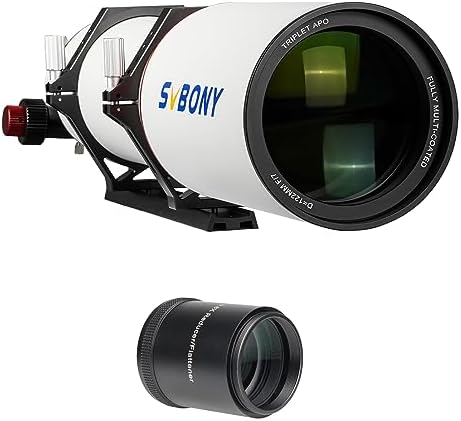
This bundle combines the SV550 122mm APO refractor with the SV209 0.8X focal reducer field flattener designed specifically for prime focus astrophotography. The reducer corrects field curvature and provides a wider field of view improving imaging quality at the edges.
We may earn a commission when you buy through this link, at no additional cost to you.
The 122mm aperture gathers more light offering clear and detailed images suitable for deep sky photography. It uses a FPL-51 triplet apochromatic lens structure containing one piece of ED glass to greatly reduce chromatic aberration and enhance sharpness.
Although the large aperture provides better limiting magnitude the weight requires a stable mount for successful imaging. The focal reducer improves shooting efficiency but the overall package remains heavy making spontaneous setup more challenging than lighter options.
For astrophotographers seeking maximum field correction and light gathering this bundle is an excellent investment. The included accessories ensure optimal imaging performance without needing to source separate components separately.
The 0.8X reducer provides a wider field of view and reduces exposure times while correcting field curvature for sharper edges.
The 122mm aperture collects substantial light allowing detection of fainter deep sky objects compared to smaller apertures.
We may earn a commission when you buy through this link, at no additional cost to you.
The SVBONY SV550 122mm Triplet APO Telescope Kit offers a complete package with a field flattener and dovetail base. It uses FPL-51 triplet apochromatic lens structure containing one piece of ED glass to reduce chromatic aberration and enhance clarity and sharpness.
We may earn a commission when you buy through this link, at no additional cost to you.
The included SV209 0.8X focal reducer field flattener is designed specifically for prime focus astrophotography. It corrects the defect of field curvature improving imaging quality and shooting efficiency of the edge of the field of view.
While the kit includes essential accessories the telescope weighs around 6.44kg requiring a stable mount. The larger aperture gathers more light for clear images but the weight and price make it less portable than 80mm models.
For photographers wanting a comprehensive solution with included accessories this kit is highly recommended. It simplifies setup by providing necessary components to achieve wide-field and sharp imaging results.
Includes field flattener and dovetail base ensuring all essential components are ready for immediate astrophotography use.
FPL-51 triplet optics provide excellent correction ensuring high-quality images with minimal color fringing.
We may earn a commission when you buy through this link, at no additional cost to you.
This SVBONY SV550 80 triplet APO Telescope Kit features 80mm aperture and F6 focal ratio. The triplet apochromatic optics structure includes S-FPL51 low-dispersion ED glass improving blue-edge chromatic aberration for sharp image quality.
We may earn a commission when you buy through this link, at no additional cost to you.
The package includes SV209 field flattener which effectively improves image quality by correcting field curvature. It comes with a comfortable carrying handle making the OTA easy to transport and install safely during setup.
While the compact design is great for travel the kit lacks eyepieces for visual observing. The focus may require careful adjustment due to the field flattener configuration but the optical correction provides excellent results.
For those prioritizing portability and included accessories this kit offers great value. It allows quick setup for imaging targets without needing to source separate flattening accessories.
SV209 field flattener ensures flat field performance for imaging targets eliminating the need to buy it separately.
Comfortable carrying handle and compact size make this telescope easy to transport for spontaneous observing sessions.
We may earn a commission when you buy through this link, at no additional cost to you.
This bundle includes the SV550 APO 122mm F7 triplet refractor along with a mini guide scope and telescope camera. The scope uses FPL-51 triplet apochromatic lens structure containing one piece of ED glass to reduce chromatic aberration and enhance clarity and sharpness.
We may earn a commission when you buy through this link, at no additional cost to you.
The included SV905C camera is a compact highly sensitive 1.23-megapixel color camera perfect for autoguiding. It features high peak QE and low read noise allowing tight tracking of faint guide stars for stable long-exposure imaging.
While the camera sensor is small limiting imaging quality for primary capture it serves well for guiding. The guide scope bracket and camera add weight requiring a sturdy mount for stable performance.
For users seeking a ready-to-go autoguiding solution this bundle simplifies setup significantly. The integrated components ensure accurate tracking essential for capturing deep sky objects with precision.
Included mini guide scope and camera enable autoguiding capability ensuring precise tracking during long exposures.
Comes with necessary imaging components allowing immediate setup without needing additional accessory purchases.
We may earn a commission when you buy through this link, at no additional cost to you.
Selecting the right apochromatic refractor requires understanding key optical and mechanical factors that affect image quality and usability. We have outlined the essential considerations to help you make an informed decision.
Aperture determines how much light the telescope gathers influencing visibility of faint deep sky objects. Larger apertures like 100mm or 122mm provide better resolution but add weight and require sturdy mounts.
Prioritize aperture based on your transport needs and light conditions to balance performance and portability effectively.
Apochromatic refractors use triplet or quadruplet designs with extra-low dispersion glass to eliminate color fringing. Air-spaced lenses help maintain temperature stability and optical alignment.
Choose a design that matches your imaging requirements ensuring minimal chromatic aberration across the entire field of view.
Focal ratio affects exposure times and field of view with lower numbers being faster for wide-field imaging. F6 to F7 ratios offer versatile performance for various deep sky targets.
Consider your preferred imaging style to decide on the focal ratio that best suits your photography or visual goals.
Weight and size impact transport ease and setup convenience for outdoor sessions. Look for lightweight materials like magnesium and ergonomic carrying handles if portability is a priority.
Evaluate the telescope weight relative to your typical transport methods to ensure practical usage in the field.
A high-quality dual-speed focuser and field rotator are essential for precise focusing and camera alignment. Compatibility with accessories like field flatteners ensures sharp stars across the image frame.
Check accessory compatibility and focuser quality to avoid additional purchases that might limit your system's potential.
Durable materials and precise construction ensure longevity and stable optical performance over time. Features like dew shields and extinction barriers protect optics and improve contrast.
Invest in telescopes with robust build quality to maintain optical precision and reliability during repeated use.
Price often reflects optical quality and included accessories so compare what each bundle offers carefully. Some kits include essential components that save money compared to buying separately.
Balance your budget with desired features to get the best value without compromising on critical optical performance.
Reliable customer support and warranty service provide security for your investment against potential issues. Established brands often offer better service and replacement parts availability.
Select vendors or manufacturers with a reputation for strong customer service to ensure peace of mind after purchase.
Start by mounting the telescope securely on a stable mount capable of supporting its weight. Allow the optics to reach thermal equilibrium with outside air to ensure optimal image clarity before observing.
For astrophotography use the field rotator and focuser to align your camera precisely. Ensure all connections are tight and balanced to prevent tracking errors during long exposures.
Clean optics only with appropriate lens brushes or solutions when necessary to avoid damage. Store the telescope in a dry place with covers on to prevent dust accumulation and moisture damage over time.
An apochromatic refractor uses specialized low-dispersion glass and triplet or quadruplet lens designs to minimize chromatic aberration. This results in sharper images without color fringing compared to standard refractors which often suffer from color errors at high magnification.
Yes, many apochromatic refractors are designed to be user-friendly and portable making them accessible for beginners. Their high optical quality and ease of use allow new astronomers to enjoy crisp views and start astrophotography with minimal fuss.
You will typically need a sturdy mount, eyepieces for visual observing, and a field flattener for photography. Depending on your setup guide scopes and cameras may also be necessary for astrophotography.
Some models feature push-pull adjustments for collimation while others are factory aligned. If adjustments are needed follow manufacturer instructions carefully to avoid damaging precision optical components during the process.
Yes, many apochromatic refractors are versatile enough for terrestrial viewing during daylight. Always use a proper solar filter if observing the sun to avoid permanent damage to your eyes or equipment.
Focal ratios around F6 to F7 provide a balance of field width and brightness ideal for deep sky targets. Faster ratios allow shorter exposures while slower ones give higher resolution depending on your specific imaging goals.
Yes, allowing the optics to cool to ambient temperature reduces thermal currents that distort images. Plan to let the telescope sit outside 30 to 60 minutes before observing for best results.
Use a soft brush to remove loose dust and a specialized lens cleaning solution sparingly if needed. Avoid touching the glass surface directly and wipe gently in a circular motion to prevent scratches or residue.
We have reviewed ten top apochromatic refractors offering options for various budgets and skill levels. From compact 80mm triplets to larger 122mm imaging bundles each model brings unique strengths to astronomy enthusiasts.
Prioritize optical performance and portability based on your specific observing needs to ensure satisfaction with your purchase. Balancing features with practical considerations will lead to a successful and rewarding viewing experience.
Remember that prices and availability fluctuate frequently so verify current details on product pages before buying. This ensures you secure the best value and accurate specifications for your chosen telescope model today.